Release Date: October 10, 2025 (United States theatrical)
(Premiere: January 24, 2025 at Sundance)
Runtime: 133 minutes (1 hr 53 min)
Rated: R — for language, some drug use and bloody images.
Production Companies: A24, Central Pictures, Fat City, also credited: Bronxburgh; Elara Pictures
Producers: Sara Murphy, Ryan Zacarias, Ronald Bronstein, Josh Safdie, Eli Bush, Conor Hannon, Richie Doyle
Cinematography: Christopher Messina
Editing: Lucian Johnston
Music / Composer: Melissa Chapman & Annie Pearlman
If I Had Legs I’d Kick You
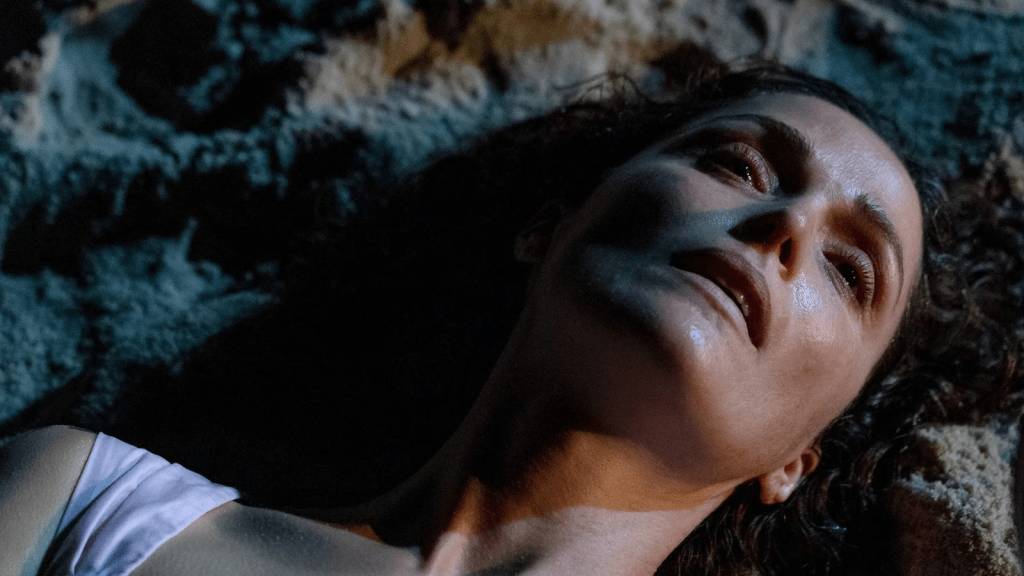
Director & Screenwriter: Mary Bronstein
Starring: Rose Byrne, Conan O’Brien, Danielle Macdonald, Christian Slater, A$AP Rocky
Being called “Uncut Gems for motherhood” isn’t hyperbole. Mary Bronstein’s If I Had Legs I’d Kick You throws you into the chaos of Linda’s unraveling life — chaos that hums and howls at a frequency that feels uncomfortably real. Rose Byrne anchors the film with a tour-de-force performance, embodying a woman caught at the volatile intersection of love, obligation, exhaustion, and unspoken rage. At what could be described as both the peak of motherhood and the peak of her anxiety, Linda is hanging by threads that fray a little more with every passing scene.
Bronstein builds her story around Byrne, who is in virtually every frame. Her performance is layered with nuance: shifting between brittle strength, uncontainable frustration, and flickers of hope so brief they feel like hallucinations. Through Linda, we glimpse the unspoken toll of caretaking, work, and the relentless external forces — those seemingly “small” factors beyond our control — that grind away at the soul over time.

The film scrutinizes Linda relentlessly, locking us into her rhythm as she navigates life with her daughter, whose illness (alluded to as an eating disorder) casts an invisible but heavy shadow. The daughter’s face is never shown, a deliberate choice that shifts the film’s center of gravity entirely onto Linda. While this relationship is the film’s anchor, Bronstein wisely threads in other characters — some fleeting, some pivotal — whose presence either amplifies Linda’s stress or offers slivers of respite she can’t bring herself to accept. Even when they’re trying to help, Linda’s distrust, fear, and exhaustion keep her suspended in survival mode.
The filmmaking itself is intimate to the point of claustrophobia. Bronstein shoots through Linda’s perspective with an unblinking eye: extreme close-ups of her face when the walls are closing in, handheld camerawork that mirrors the jittery instability of her mind. Linda rarely smiles; instead, Byrne communicates everything — resentment, panic, bone-deep weariness — through microscopic facial shifts. A recurring audio cue, a piercing beep from the monitor she uses to track her daughter when she steps away, underscores her inability to detach, even momentarily, from her role as caretaker. These sonic intrusions become the pulse of her daily life, collapsing any space for personal stillness.
Sound and surreal imagery are Bronstein’s sharpest tools. She uses them not for show, but to translate internal experience into cinematic language. The edges of conversations blur. Background chatter dissolves into white noise. Certain images — water dripping, ceiling cracks widening, light flickering — repeat with unnerving insistence. It’s a visceral portrait of someone whose world has narrowed to the contours of crisis.
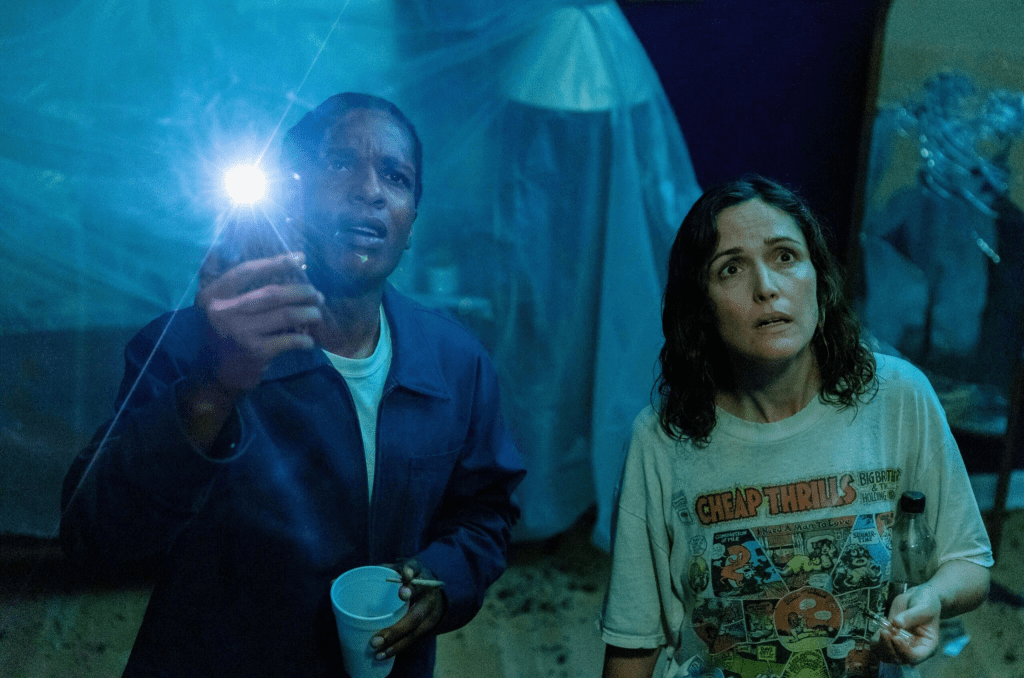
Everything in this film orbits Byrne’s performance, and she delivers nothing short of spectacular. The supporting cast drifts in and out of her world like satellites. Conan O’Brien, as her colleague-therapist, provides attempts at grounding Linda with a soft, minimal approach that never quite penetrates her walls. A$AP Rocky’s James — the motel superintendent who enters the story after a massive hole collapses in Linda’s ceiling — embodies a kind of ambiguous comfort. He floats at the periphery of her pain, both anchor and distraction. Each character offers something intangible: empathy, assistance, companionship. But none can truly offer Linda what she needs most.
If I Had Legs I’d Kick You is, at its core, a journey of self-reckoning. Linda doesn’t fully understand herself — and neither do we. That’s the brilliance of Byrne’s performance: she gives us enough to feel her unraveling but withholds the neatness of resolution. We don’t know where she’s going next because she doesn’t know where she’s going next. In a year full of films dissecting parenthood, Bronstein’s approach is singular in its rawness. There’s a quiet, devastating beauty in the way Linda wears her emotions — not as armor, but as open wounds.
The sound design deserves its own praise. Bronstein pairs her intimate camera with sound that destabilizes the viewer: the slow build of background noise, voices fading in and out, sharp tonal beeps, and distorted ambience. These choices don’t just heighten tension — they place us inside Linda’s headspace, forcing us to experience her hyperfixations and her fleeting moments of relief. Edits cut with jarring precision, and transitions mimic the fractured nature of a mind under constant strain.
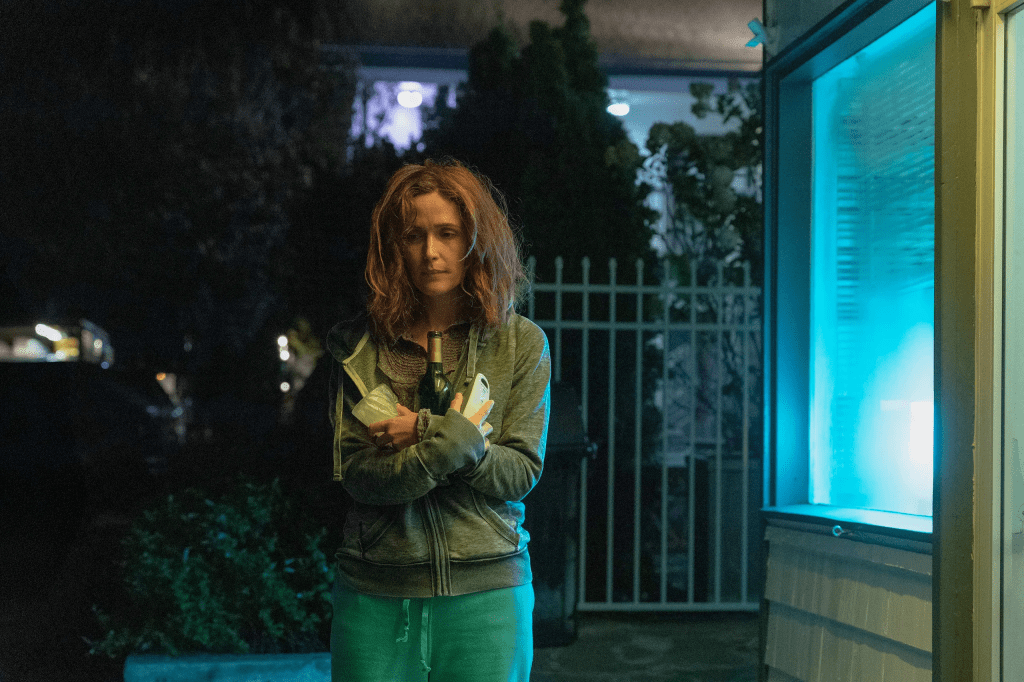
As the film progresses, so does Linda’s mounting dread. Bronstein builds the anxiety with expert precision, lingering on quiet, seemingly mundane moments that later reveal themselves as emotional detonators. These symbolic beats accumulate, pushing both Linda and the audience toward an inevitable breaking point. The final act is a gut punch — not because it offers easy answers, but because it doesn’t. The climax lands with clarity that feels both earned and fleeting, leaving Linda in a space of ambiguous possibility.
We don’t know where she’s headed. But that’s part of the film’s haunting power: clarity doesn’t always mean resolution. Sometimes, it’s just the quiet before the next storm.
 818 Lens