Release Date: Limited US release August 15, 2025
Runtime: 80 minutes (1h 20min)
Rated: R for severe violence and gore, severe profanity, severe alcohol, drug and smoking use, moderate sex and nudity, moderate frightening and intense scenes
Production Companies: Channel 83 Films, Media Capital Technologies, associated with The Horror Section / Iconic Events Releasing
Producers: Joe Begos (also producer), plus Josh Ethier, Matt Mercer, Josh Russell, Sierra Russell, (with executive producers named in some full-crew lists)
Cinematography: Brian Sowell & Mike Testin
Editing: Josh Ethier
Music / Composer: Steve Moore (original music)
Jimmy & Stiggs (2025)
Director & Writer: Joe Begos
Starring: Joe Begos & Stiggs Randolph
As part of Eli Roth’s first release under his new production company, The Horror Section, Jimmy & Stiggs manages to land the plane as an absurd, bright, neon-colored practical comedy that successfully bleeds into horror through its gore and thematic underpinnings of addiction—whether to heroin, alcohol, or drugs in general. Joe Begos stars alongside Matt Mercer as best friends Jimmy and Stiggs, and together they deliver convincing performances of two old friends reconnecting. One has been spiraling into paranoia, his descent fueled and enabled by substance abuse, while the other has been sober for months and is suddenly forced to test not only his loyalty but also his ability to survive when thrown into a dire, intoxicated nightmare.
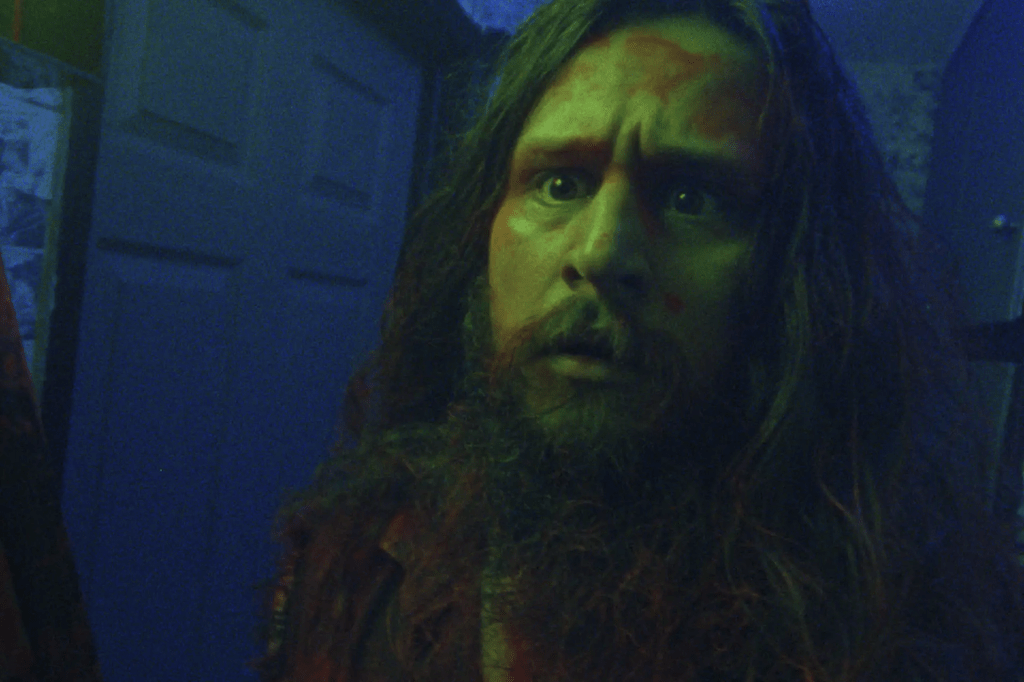
The tone of the film is restless and relentless, almost anxiety-inducing. Begos, in particular, carries the weight of the film by embodying a protagonist who feels constantly on edge—paranoid, eccentric, and never still, because his system is completely flooded by alcohol and drugs. This makes for a viewing experience that feels like your heart is racing at 100 beats per minute. It doesn’t let you breathe, and in some moments it becomes almost overwhelming. While this imbalance could have been tempered for greater effect, the exaggerated and hyperbolic nature of the film means that the constant energy still fits the aesthetic. Begos’ aggressively unhinged performance dovetails with the film’s overall zany, heightened tone—even if there are stretches where a little restraint might have helped.
This story feels perfectly suited to Roth’s sensibilities, told in a ludicrous, hyperbolic manner. Begos leans into the unreliable perspective of a protagonist whose system is saturated with substances and whose heightened emotions are constantly being tested, especially as his past and fractured relationship with Stiggs are slowly revealed. Stiggs, entering midway through the story, disrupts and reshapes the narrative, turning the film into a uniquely chaotic and surprisingly heartfelt exploration of both paranoia and friendship. What Begos delivers here is a narrative that feels as inventive as it is strange—made all the more memorable by its practical effects, semi-comedic beats, and over-the-top acting that somehow remains grounded enough to work in such a bizarre scenario.
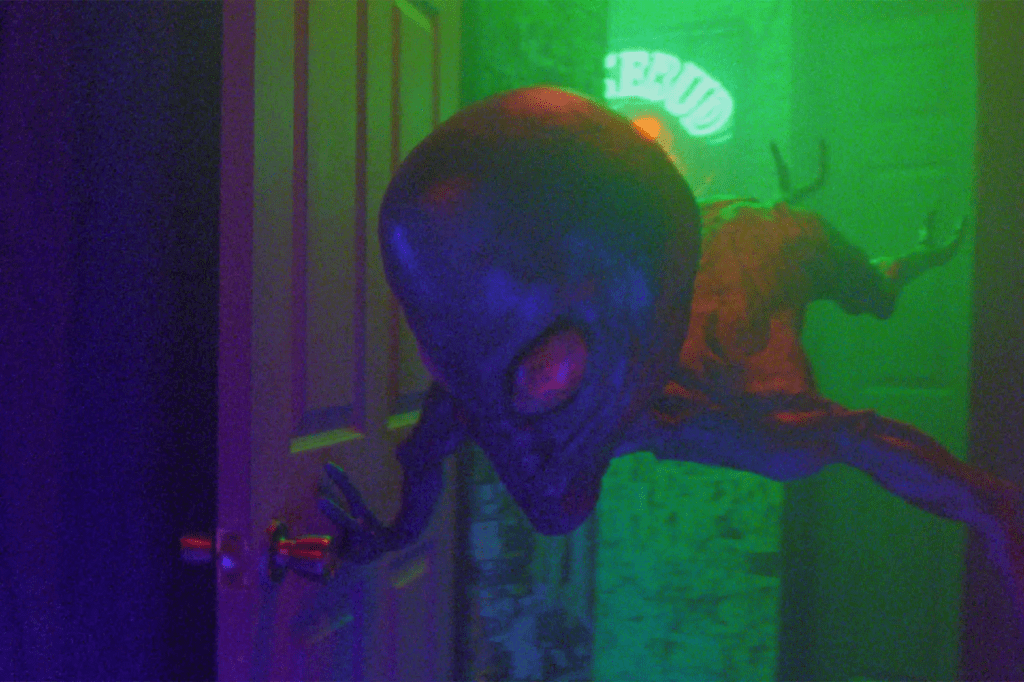
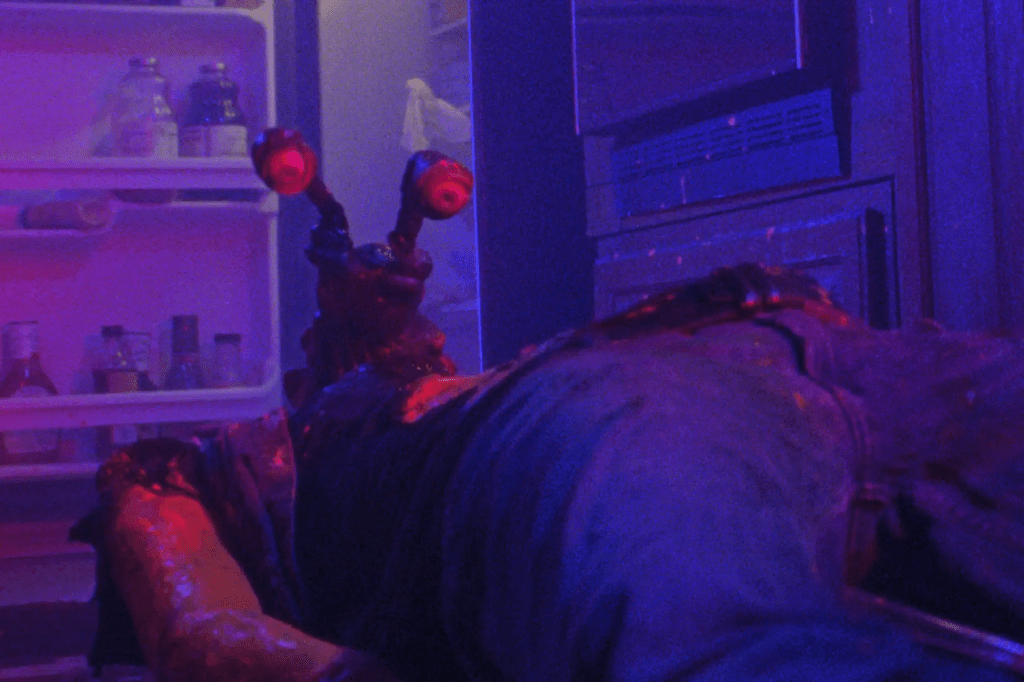
The aliens in Jimmy & Stiggs deserve special mention. They are practical to the core—clearly puppets or muppet-like creations—and their deliberately absurd design matches the film’s offbeat tone. Many might dismiss them for looking silly, but the silliness is the point. The aliens aren’t here to be frightening or hyperrealistic; they’re here to be foils for the characters’ frustrations and vehicles for comedic physical altercations. What makes them effective is precisely that physicality—objects and bodies clashing in over-the-top, gory ways. In a cinematic world so often dominated by glossy CGI, their tactile, imperfect absurdity feels refreshing and oddly authentic, amplifying the film’s satirical edge.
The concept of extraterrestrial contact itself is hardly new, but Begos’ approach—blending paranoia with themes of broken relationships and the destructive allure of substance abuse—brings fresh energy. The entire story plays out in a confined space, almost exclusively within an apartment, which enhances the claustrophobia and absurdity of the situation. Begos used his own apartment, which he and his crew had years to customize for the shoot, and the authenticity of that space gives the film a lived-in quality that adds to the immersion. Shot on 16mm, the result is claustrophobic, chaotic, and absurd in equal measure—and all the better for it.
Before the main feature, Roth introduces two “previews” that set the tone not just for this film, but for The Horror Section’s ethos as a whole:
- “The Piano Killer” — a parody-style trailer for a film about a literal piano that kills people in the most ridiculous, implausible ways.
- “Bitch, Don’t Go In That House” — a collaboration with Snoop Dogg, riffing on urgent, satirical titles like Jordan Peele’s Get Out, Us, and Nope.
These previews do more than serve as jokes; they establish a playful foundation for the company’s identity, promising audiences that Roth’s new venture will embrace the bizarre, the satirical, and the excessive. In the theater, these previews actually got laughs and audible reactions from the crowd, and their polished execution helped prime the audience for the tone of Jimmy & Stiggs. They also make the film feel like part of a larger creative experiment in genre filmmaking.
The practical effects—aliens, gore, and everything in between—give the film a tactile, gritty energy often missing from CGI-heavy productions. Like Jurassic Park, whose dinosaurs remain iconic precisely because of their physicality, Jimmy & Stiggs benefits from the imperfect tangibility of its effects. Even when the creatures border on ridiculous, their presence feels real in a way that digital effects rarely capture.
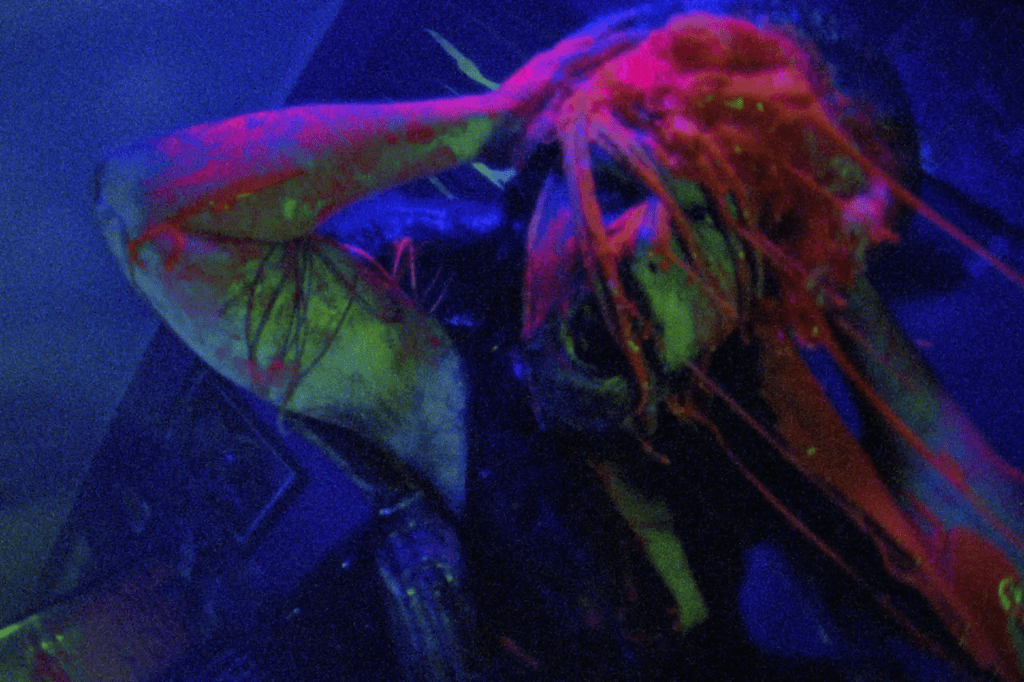
Performance-wise, Begos and Mercer carry the film. Their chemistry and dynamic anchor the madness, and their portrayal of a fractured but necessary friendship makes the narrative resonate beyond its spectacle. The dialogue may falter at times, but the emotional weight and authenticity of their relationship smooth over the rough edges.
That said, this is not a film for everyone. As an independent production and the first of its kind under Roth’s banner, it carries the experimental feel of trial and error. But for fans of niche horror—particularly those who love the neon-soaked zaniness of cult cinema—this film feels like a worthy spiritual successor. Horror fandom has always thrived on originality and loyal niche audiences, and Jimmy & Stiggs taps directly into that vein.
Originality, of course, is slippery in modern cinema. Almost every concept has been done before; what matters now is execution, perspective, and style. Begos’ spin on an alien-invasion story may not reinvent the wheel, but it thrives in its commitment to practical effects, eccentric humor, and a raw, indie sensibility. His film feels personal and daring, and even when it swings wildly, those swings demonstrate a filmmaker unafraid of failure.
As someone who has recently been more aware of Eli Roth’s work, I admit his previous film Thanksgiving won me over as a sharp piece of camp horror. Seeing his name attached to this project sparked anticipation, and Begos didn’t disappoint. In fact, Begos proves himself to be a smart investment for Roth—an artist with vision, scrappiness, and the ability to wring something ambitious out of limited space and resources.
In a media landscape often cluttered with safe, polished blockbusters, Jimmy & Stiggs stands as a testament to the enduring power of independent horror, practical effects, and wild creative risks. It may not win everyone over, but it doesn’t need to. It’s for the loyal, growing audience of fans who value originality, cult aesthetics, and the beautiful messiness of genre filmmaking.
 818 Lens