Release Date: limited U.S. release November 14, 2025 (Neon)
Runtime: 89 minutes (1h 29m)
Rated: PG
Production Companies: Remembers, MountainA, France 3 Cinéma, Fit Via Vi Film Productions, Sons of Rigor
Producers: Félix de Givry, Sophie Mas, Natalie Portman, Ugo (Ugo/Ugo Bienvenu) Bienvenu (producer credits)
Animation/Visual leads: Adam Sillard (animation lead) and Fabio Besse (production design)
Editing: Nathan Jacquard
Music / Composer: Arnaud Toulon
Arco (2025)
Writer(s): Ugo Bienvenu & Félix de Givry
Starring (English Cast): Juliano Krue Valdi, Romy Fay, Natalie Portman, Will Ferrell, Andy Samberg, Flea, America Ferrera, Mark Ruffalo
Neon has had an eclectic and undeniably strong year for film, with several titles already floating around awards-season conversations (and rightfully so). But when a distributor’s slate becomes this stacked, it’s inevitable that some gems will slip under the radar while others dominate the spotlight. I haven’t dipped my toe into much animation this year — at least not beyond the anime boom currently shaping the cultural moment, with juggernauts like Demon Slayer or Chainsaw Man continuing to shape the mainstream. Meanwhile, the nostalgia crowd saw a resurgence in slapstick animation with The Day the Earth Blew Up: A Looney Tunes Movie. And of course, one of the biggest box-office openings of the year came from a sequel many are already calling better than the original — Zootopia 2.
Still, there’s something genuinely refreshing about seeing animation departments rally, innovate, and push against the looming discourse around AI-generated art “coming” for their jobs. Films like Arco prove how irreplaceable the human touch is — how difficult it really is to emulate something as simple as sincerity, or as complex as feeling. Ugo Bienvenu’s Arco is a prime example of this: a hand-drawn, deeply human, visually vibrant world that breathes life through its young, curious characters and through a near-future setting that mirrors our emotional realities more than we might care to admit. And importantly — it’s not IP. It’s original. Another mark of Neon’s sharp, risk-taking curation this year.
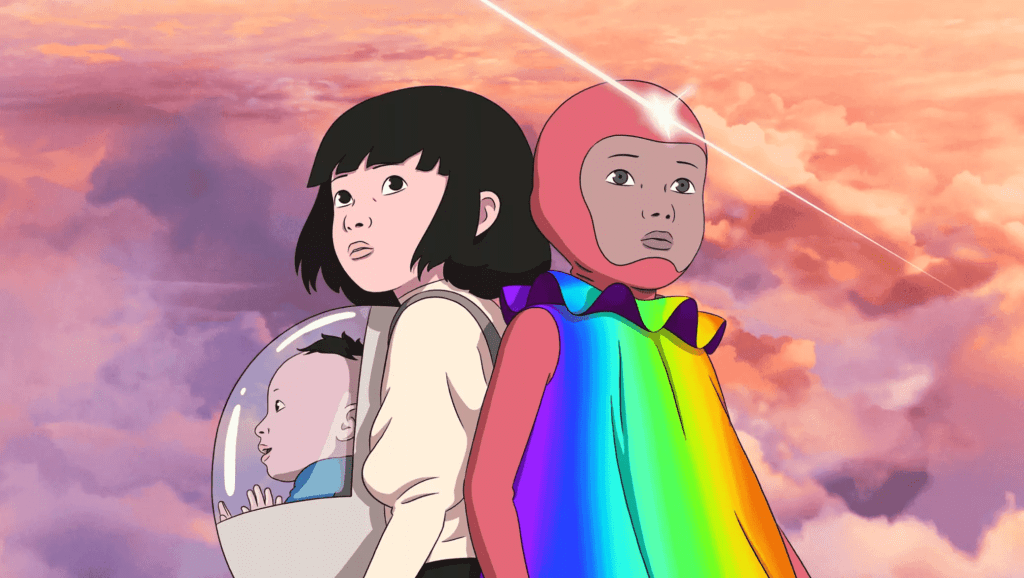
Arco follows its titular character, Arco (voiced by Juliano Krue Valdi in the English dub; Oscar Tresanini in the French original), a young, naive boy living in a far-flung future where flight and time travel are as natural as riding a bike. Still learning to control his rainbow-colored flying suit — a rite of passage in his time — Arco grows impatient with waiting until he’s old enough to travel on his own. When curiosity finally wins out, he attempts a solo flight and accidentally slips through time, crash-landing in the year 2075. This is where he meets Iris (voiced by Romy Fay), a young girl navigating life mostly on her own with the help of her robotic caretaker, Mikki (voiced by Mark Ruffalo), while also caring for her baby brother.
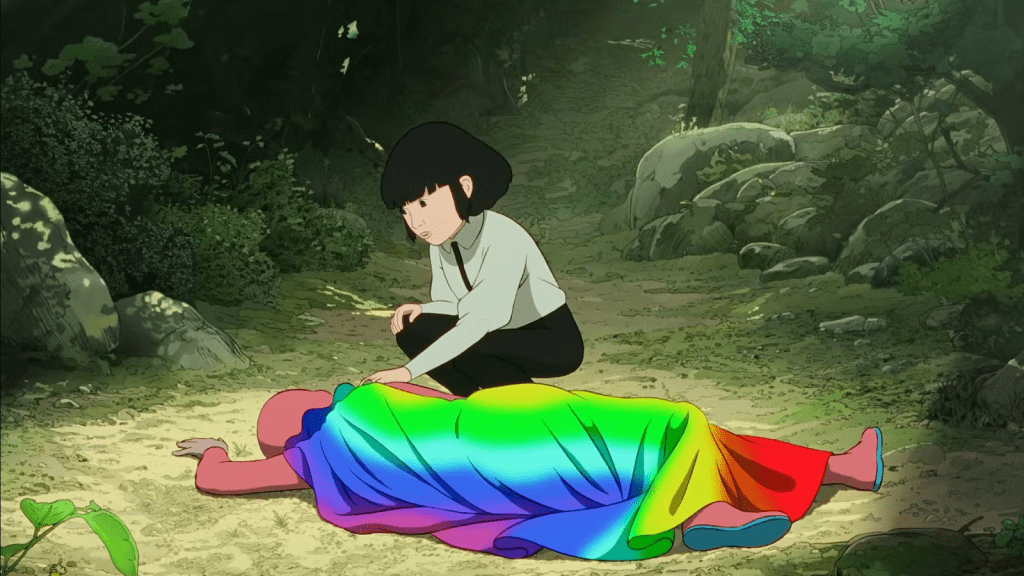
This chance encounter lays the foundation for the film and does so with a charm and originality that evoke shades of Hayao Miyazaki — not in imitation, but in shared spirit. The misconception adults often have about animated storytelling is that it’s somehow a lesser viewing experience for them than it is for children. And while it’s true that certain animated films skew younger, it’s equally true that just as many speak universally to anyone willing to meet them halfway. One could argue, even, that all art functions this way — and Arco leans into that universality with gentleness and intention.
The film’s perspective, filtered through the emotional vocabulary of two children, remains consistently endearing. Both Arco and Iris carry a surprising emotional weight on their shoulders — one shaped by curiosity and longing, the other by responsibility and absence — and it’s through each other that these burdens become manageable. Their friendship grounds the film, turning its futuristic premise into something deeply tender and deeply human.
Throughout their journey, we witness two timelines, two worlds, and two entirely different ways of growing up collide. Arco and Iris explore Iris’s world together, sharing pieces of their lives, teaching each other what they’ve learned in their short but formative years, and navigating how strangely beautiful it is that they ever crossed paths at all.

Iris’s parents aren’t neglectful by choice — work keeps them away physically, leaving hologram projections as their only means of being “present,” while Mikki handles the day-to-day caregiving. Arco, in contrast, comes from a family who appears close-knit, but his impatience and lack of control over time travel lead to unintended consequences that separate him from them. This sets the stage for his partnership with Iris, as the two devise a plan to return him home. At the same time, Arco fills a quiet emotional gap in Iris’s life — the gap created by the absence of her parents — while she becomes his anchor in this strange new timeline, guiding him through a world that is as unfamiliar to him as the future is unimaginable to her.
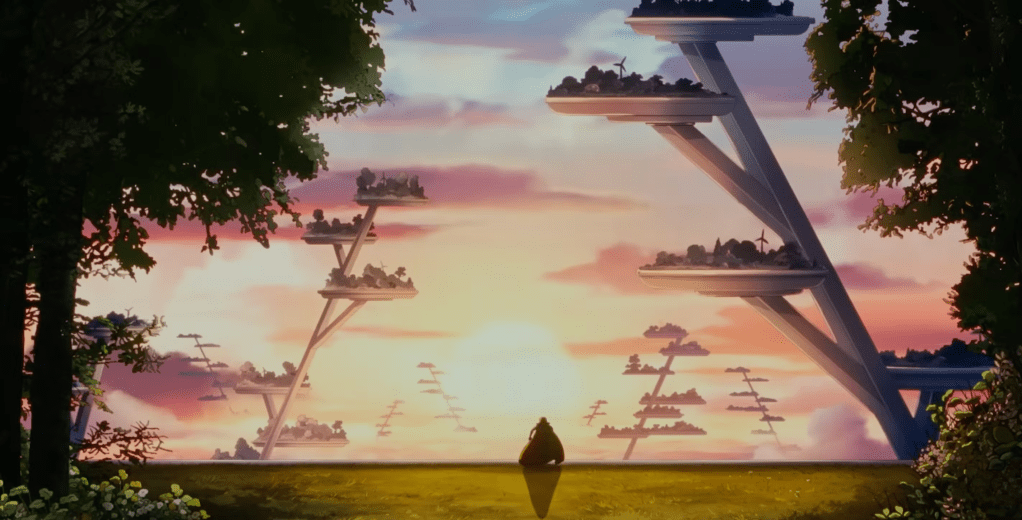
The writing isn’t the only element that elevates this film’s emotional resonance. Visually, Arco carries those Miyazaki shades I mentioned earlier — not as imitation, but as an echo of that same imaginative warmth — while still standing firmly on its own feet. The world Bienvenu and his team craft deserves its flowers. Even in the film’s most chaotic, high-stakes moments, the environment remains rich with detail, bursting with textures and tiny visual cues that keep your eyes drifting around the frame. You’ll recognize pieces of our world and latch onto them instinctually, but the further you sink into the film, the more you realize how different it is — sometimes for the better, sometimes for the worse, always in service of the story’s emotional impact.
Ultimately, what Bienvenu delivers is a story steeped in childhood wonder, stretched across time and memory, set in a future that still feels familiar in all the ways that matter. It’s filled with those timeless threads — friendship, longing, responsibility, loss, curiosity — the kind that can get even the toughest adults to smile, and maybe, if the film catches them at the right moment, shed a tear.
There are so many themes at play here, each layered with its own quiet nuance. Iris’s loneliness, which becomes softened and reshaped by Arco’s sudden arrival, gives many of the film’s emotional beats their unexpected weight. Even with Mikki present as her caretaker, the film constantly challenges and questions just how much a robot can realistically fulfill — yes, the physical needs, but also the emotional labor that no machine can truly replicate. Meanwhile, the parents of both children are thrust into predicaments they never anticipated, forced to confront situations they didn’t even know existed until their children collided across time. The irony is that the solutions they scramble to find were already being fulfilled — instinctively, beautifully — by Arco and Iris for one another. Sometimes the silver lining in the storm cloud isn’t just a highlight; sometimes it’s the thing that quietly saves everyone involved.
Ultimately, Arco is a film that sneaks up on you. What begins as a colorful, whimsical time-travel adventure gradually reveals itself to be something far deeper — a story about connection, longing, and the emotional bridges children build long before adults even realize they’re needed. Bienvenu crafts a world that feels wondrous and lived-in, yet always human at its core, a reminder that even in imagined futures, our oldest desires — to be seen, to be understood, to be held — remain unchanged.
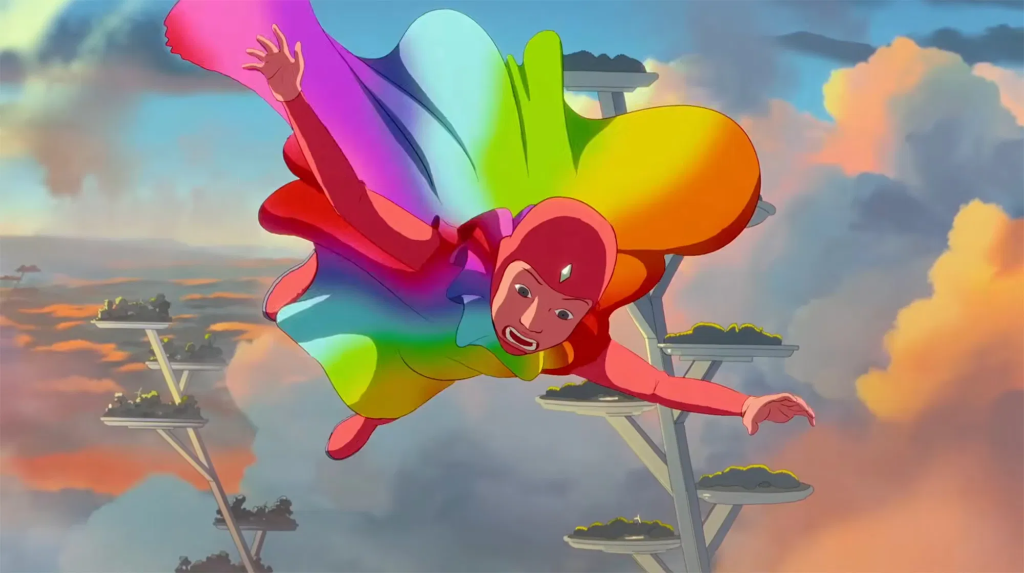
In a year overflowing with sequels, spectacle, and IP-driven noise, Arco stands out precisely because it isn’t any of those things. It’s tender. It’s original. It’s made with intention. And Neon’s decision to champion a hand-drawn, emotionally rich film like this feels like a vote of confidence in animation as a medium of sincerity, not just entertainment.
If anything, Arco is proof that the most quietly ambitious films are sometimes the ones that linger the longest. It invites you in with wonder, holds you with feeling, and leaves you thinking not about the future it presents, but about the parts of yourself you recognized within it. And that — especially in the ever-evolving landscape of animation — is its own kind of magic.
 818 Lens