Release Date: November 14, 2025 (U.S. Release)
Runtime: 115 minutes (1h 55m)
Rated: R
Production Companies: Los Desertores Films AIE, Telefónica Audiovisual Digital, Filmes da Ermida, El Deseo, Uri Films, 4A4 Productions
Producers: Domingo Corral, Óliver Laxe, Xavi Font, Pedro Almodóvar, Agustín Almodóvar, Esther García, Oriol Maymó, Mani Mortazavi, Andrea Queralt
Editing: Cristóbal Fernández
Music / Composer: Kangding Ray (also known as David Letellier)
Sirāt (2025)
Writer(s): Óliver Laxe & Santiago Fillol
Starring: Sergi López, Bruno Núñez Arjona, Richard Bellamy, Stefania Gadda, Joshua Liam Henderson, Tonin Janvier, Jade Oukid
The bad-feel movie of the year, Óliver Laxe’s visceral and gut-punch Sirāt explores familiar, deeply human themes from a standpoint that summons the strongest emotions and the bleakest thoughts. Breathtakingly austere landscapes are juxtaposed with heavy psychological and existential beats, grounding the film in a sense of beauty that feels both entrapping and transcendent. Sirāt puts on a stellar show with an ensemble of non-professional and first-time actors, many of them discovered directly from the environments Laxe recreates onscreen.
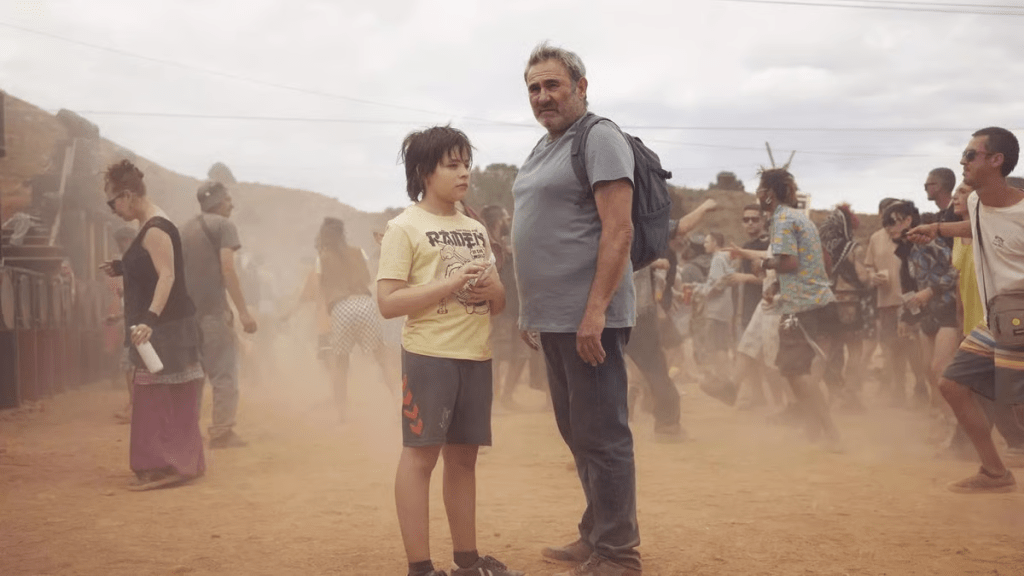
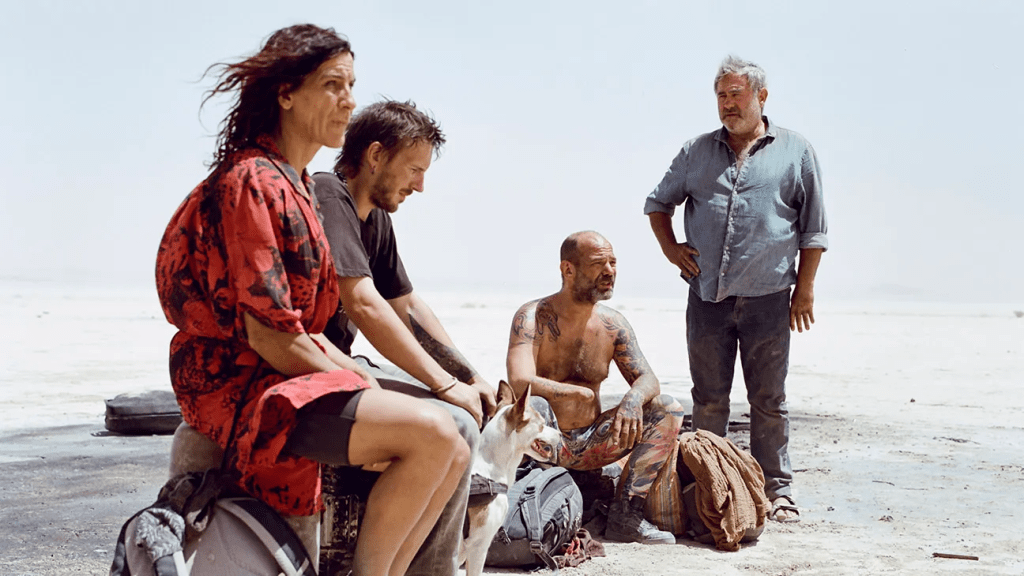
Following the quintessential structure of the road-trip, “journey” narrative, Laxe places our protagonist Luis (Sergi López) and his son Esteban (Bruno Núñez Arjona) against the backdrop of a desert rave on the precipice of global collapse — this time, the threat of a looming world war. Their aim is simple yet piercing: they are searching for Luis’ daughter, Mar. Along the way, they fall in with a rag-tag group of ravers who have built their own found-family dynamic: Bigui (Richard Bellamy), Stef (Stefania Gadda), Josh (Joshua Liam Henderson), Tonin (Tonin Janvier), and Jade (Jade Oukid). Each carries their own reason for drifting from their blood families and for finding solace in music, movement, and the chaotic freedom of the festival circuit.
What begins as a disappearance-driven mystery slowly transforms into something more introspective and internal. The film shifts its attention toward Luis and Esteban’s unspoken resentments, buried grief, and unarticulated needs. The journey forces both of them — often unwillingly — to confront sentiments they never imagined surfacing under circumstances like this. There’s a rough, lived-in charm within this newly merged family unit, one that Luis resists before gradually finding himself disarmed by it. The skepticism that initially divides the two groups ultimately gives way to camaraderie, conflict, and genuine emotional growth — the good, the bad, and the devastating.
Laxe dives deeply into the inner self, staging a series of emotionally charged scenarios that oscillate between tenderness and brutality. Some sequences offer unexpected softness, while others land like a punch straight to the chest. But regardless of the direction each moment takes, you feel all of it — fully.
There are a few key components that carry this film. Beyond the stellar cast and the emotional precision they bring, the music plays a crucial role in shaping the film’s atmosphere. It doesn’t just underscore scenes — it sets the emotional temperature. In certain moments it heightens the intensity, pushing the film into something almost overwhelming, while in others it allows a gentler current to seep through. The sound work overall remains consistently excellent, guiding us through Laxe’s shifting emotional terrain without ever calling undue attention to itself.
The desert setting itself becomes a major force in the narrative. Its openness, dryness, and subtle sense of danger create an environment that is at once expansive and suffocating. Isolation becomes a character of its own. When Luis and Esteban impose themselves on the group out of sheer desperation to find Mar, the environment pushes against them — the heat, the distance, the landscape’s indifference. Luis reacts to these pressures with a relentless determination, and the film makes these choices matter. They ripple throughout the story like waves in still water, each one connecting to an emotional consequence or a shift in the relationships.

The dynamic between Esteban, Luis, and the group is also central to the film’s emotional pull. There is an immense heaviness weighing on the world we’re thrust into — a missing daughter, a global crisis hanging overhead, and the group’s own histories and physical hardships, from missing limbs to buried trauma. Because there is so much darkness saturating the environment, the moments of humanity shine even brighter. But that contrast also works the other way: the darker beats hit hard and linger. They don’t dissipate quickly; they sit beside the characters, burdening them — and us — long after individual scenes pass.
As many flaws as these characters may carry, the essence of their charm—once we finally sit with them—becomes undeniable and rises above the rest. You can see their histories in their scars, as you’ve already woven in earlier. Whether those wounds are external, like a missing limb, or internal, like the quiet moment Luis and Jade share about the weight they’ve been carrying, this group is constantly confronted with situations that push them into emotional corners. And in those corners, what emerges is the raw, human stuff that keeps people going.
Even with the looming threat of war pressing in from the outside, and the personal urgency of a father searching for the missing piece of his heart, these characters repeatedly choose love over bitterness, connection over retreat. The results are unpredictable—bleak in some stretches, unexpectedly tender in others—but they offer a spectrum of emotions, small beats, and charged moments that linger long after they’ve passed.

What lingers most after Sirāt isn’t the chaos of the world Laxe builds, but the quiet truth that emerges from inside it. Once the dust settles, you’re left with a film that stays pressed against your chest — heavy, warm, unsettling, and human all at once. Laxe isn’t interested in comforting you; he’s interested in revealing something truer: that connection can bloom in the most fractured spaces, that people can still show up for each other even while everything else is collapsing, and that tenderness doesn’t cancel out the pain — it coexists with it. Sirāt leaves you with that coexistence, that strange blend of ache and grace, and it’s what makes the film so difficult to shake. It may be the bad-feel movie of the year, but it’s also one that reminds you why we lean into stories like this in the first place: to feel something real, even when it hurts.
 818 Lens