Release Date: theatrical release in U.S. on August 22, 2025
Runtime: 101 minutes (1h 41min)
Rated: R for language throughout and some sexual content
Production Companies: High Frequency Entertainment, MeMo Films, Twin Pictures
Producers: Alex Orlovsky, Duncan Montgomery, Jack Selby, Galen Core, Olmo Schnabel, Francesco Melzi D’Eril, Marc Marrie, Charlie McDowell, Archie Madekwe
Cinematography: Pat Scola
Editing: David Kashevaroff
Music / Composer: Kenneth Blume (also known as Kenny Beats)
Lurker (2025)
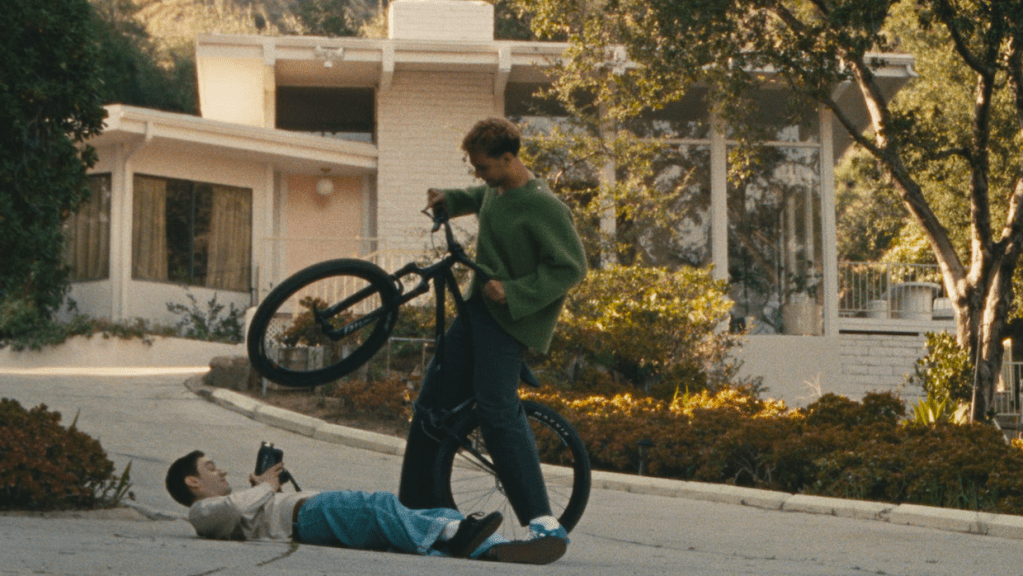
Director & Writer: Alex Russell
Starring: Théodore Pellerin, Archie Madekwe, Zack Fox, Havana Rose Liu, Wale Onayemi (Olawale Onayemi), Daniel Zolghadri, Sunny Suljic
Alex Russell’s feature debut Lurker feels like a modern companion piece to Nightcrawler—only instead of chasing gore-soaked headlines, it chases the slipperier currencies of fame, intimacy, and authorship. In a culture defined by parasocial relationships and curated personas, Russell zeroes in on the toxic symbiosis between those who create attention and those who feed off it. The result is a psychological thriller that’s both unnervingly contemporary and uncomfortably personal.
At its center is Matthew (Théodore Pellerin), who initially comes off as an unremarkable retail worker. But when pop star-on-the-rise Oliver (Archie Madekwe) wanders into Matthew’s boutique, the encounter shifts from casual small talk into something manipulative. Matthew, knowing more than he lets on, swaps the store playlist for an old school track he’s particularly fond of—one that, coincidentally, Oliver also has an interest in. This shared musical taste immediately draws Oliver to Matthew, sparking a sense of connection. What follows is less a friendship than an infiltration. Matthew offers to film Oliver’s life under the guise of making a documentary, and in doing so, gradually blurs the line between observer and participant.
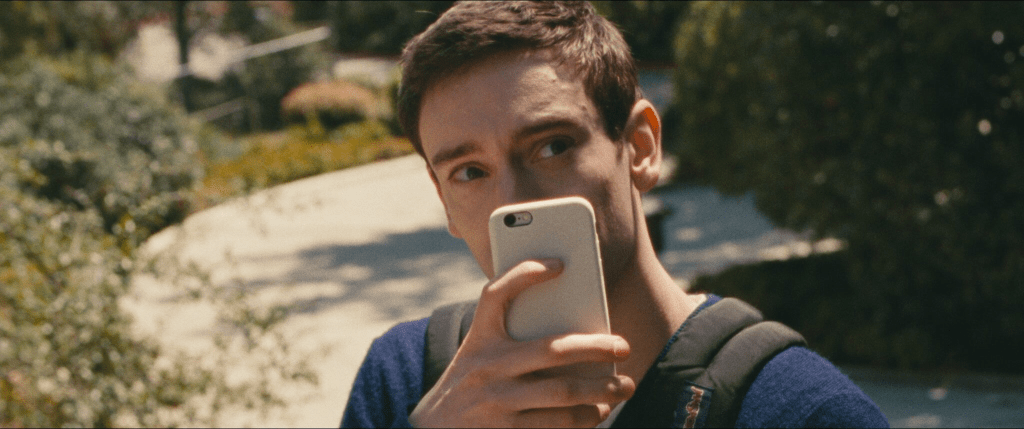
Russell pulls us into Matthew’s perspective, luring us into his loneliness, his awkwardness, and, disturbingly, his ambition. At first, we feel sympathy—here’s someone who doesn’t quite fit, someone looking for meaning through art. But as Matthew embeds himself deeper into Oliver’s world—attending recording sessions, mingling with friends, subtly controlling how Oliver presents himself—we begin to question our own alignment. Are we rooting for him, or recoiling from him?
What makes Lurker more complex is that Oliver is hardly a victim in the traditional sense. Madekwe plays him as both magnetic and hollow—a star who craves attention yet struggles with genuine connection. His charisma masks insecurities that Matthew quickly exploits, but his need for validation also makes him complicit in the manipulation. Their dynamic becomes less predator-and-prey than mirror-and-mirror: two men locked in a cycle of mutual exploitation.
Russell’s style emphasizes this tension. The score, composed by Kenneth Blume (aka Kenny Beats), weaves between ethereal calm and suffocating intensity, syncing perfectly with the emotional beats of the film. Fast, staccato tracks heighten scenes of anxiety and surveillance, while slower, melancholy pieces cradle the moments of vulnerability. It’s music as manipulation—echoing the same push-and-pull power games playing out on screen.
Reflecting on the use of music, it’s clear that Kenny Beats’ score was integral in guiding the emotional tone of the film. As a rising pop star, Oliver’s world demands a soundtrack that speaks to both his fame and his internal conflict. In Lurker, the music does more than set the scene—it enhances every shift in mood, from anxiety-inducing scenarios to moments of epiphany and realization. Beats’ timing is spot on, making the most of every emotional escalation or vulnerable moment. His manipulation through sound mirrors Matthew’s manipulation of Oliver, creating an immersive experience where the score itself becomes a character.
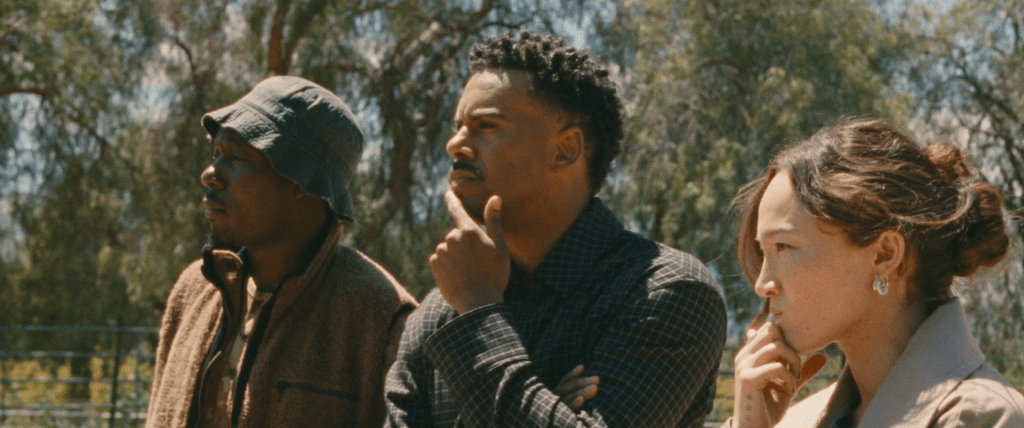
The supporting cast sharpens the paranoia. Zack Fox, Havana Rose Liu, and Sunny Suljic orbit Oliver as his confidants and collaborators, but to Matthew they’re obstacles, gatekeepers, or threats. Watching him navigate their suspicion, sometimes ingratiating himself, sometimes scheming against them, creates some of the film’s most uncomfortable moments. The dynamics between the supporting cast and the protagonists are critical in maintaining the tension and elevating the stakes as Matthew makes his way deeper into Oliver’s life. They serve as both support and counterpoint to the two leads, with each encounter adding layers to the ongoing manipulation.
The climax sidesteps expected thriller conventions. Instead of erupting into violence, the tension boils down to a symbolic but devastating power struggle. A hard drive full of footage—potentially damning, potentially fabricated—becomes the object around which trust and fear collapse. The ambiguity of whether Matthew destroyed it or not lingers after the credits, reframing the entire story as a question: who owns Oliver’s narrative? The star himself, or the one holding the camera?
This theme of manipulation and control is deftly explored through Matthew’s actions, especially his final move with the hard drive. I don’t think Matthew destroyed it, but rather kept it as a personal trophy—a testament to his success in orchestrating Oliver’s rise. In a way, the hard drive becomes a metaphor for the entire relationship between the two men, where control over the narrative is the ultimate prize. Matthew’s success doesn’t come from achieving his own goals, but from exploiting Oliver and maintaining that power over his image and story.
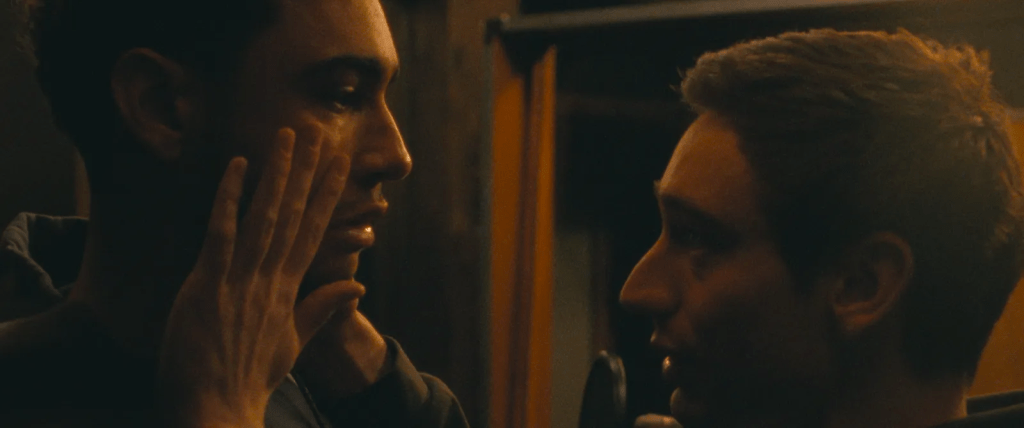
As mentioned before, the film’s treatment of parasocial relationships is spot on in our current social media landscape. It captures how celebrity culture has blurred the lines between admiration and ownership, where fans feel entitled to manipulate or invade the personal lives of those they revere. This exploitation of the relationship between celebrity and fan is so relevant to today’s world, where influencers and artists often find themselves entangled in parasocial relationships that shape their identity and career. Lurker doesn’t just examine the dangers of parasocial dynamics; it highlights how those dynamics can be used for personal gain, turning both the celebrity and the admirer into objects for consumption.
By the end, the tension between Matthew and Oliver leaves the audience questioning the nature of their bond and who truly “wins.” Both characters achieve some of their desires—Matthew securing a position of power over Oliver’s image, and Oliver gaining a level of fame and success—but at a great personal cost. Ultimately, Lurker leaves us with a profound sense of unease, as neither character is entirely worthy of sympathy or disdain. The movie forces us to reckon with how we consume and exploit each other—online and offline—and what happens when those lines are crossed.
 818 Lens