Release Date: Limited theatrical release (US) August 15, 2025
Runtime: 82 minutes (1h 22min)
Rated: R for violence and police intimidation
Production Companies: iAm21 Entertainment, Duplass Brothers Productions
Producers: Nnamdi Asomugha, Jonathan T. Baker, Ami Werges
Cinematography: Alejandro Mejia
Editing: Dana Congdon
Music / Composer: Kyle Townsend
The Knife (2025)
Director: Nnamdi Asomugha
Writer(s): Nnamdi Asomugha & Mark Duplass
Starring: Nnamdi Asomugha, Melissa Leo, Aja Naomi King, Manny Jacinto, Amari Alexis Price, Aiden Gabrielle Price
As a horror aficionado, I often gravitate toward films centered on mystery, crime, and the unsettling psychology of perpetrators. I’m fascinated by the motivations behind violent acts, the intentions that drive them, and the themes and emotions wrapped within those narratives. The Knife, directed by Nnamdi Asomugha, takes the familiar framework of a detective thriller and flips it on its head. Rather than focusing solely on unraveling the case itself, the film invites us to read between the lines of what’s unfolding on-screen.
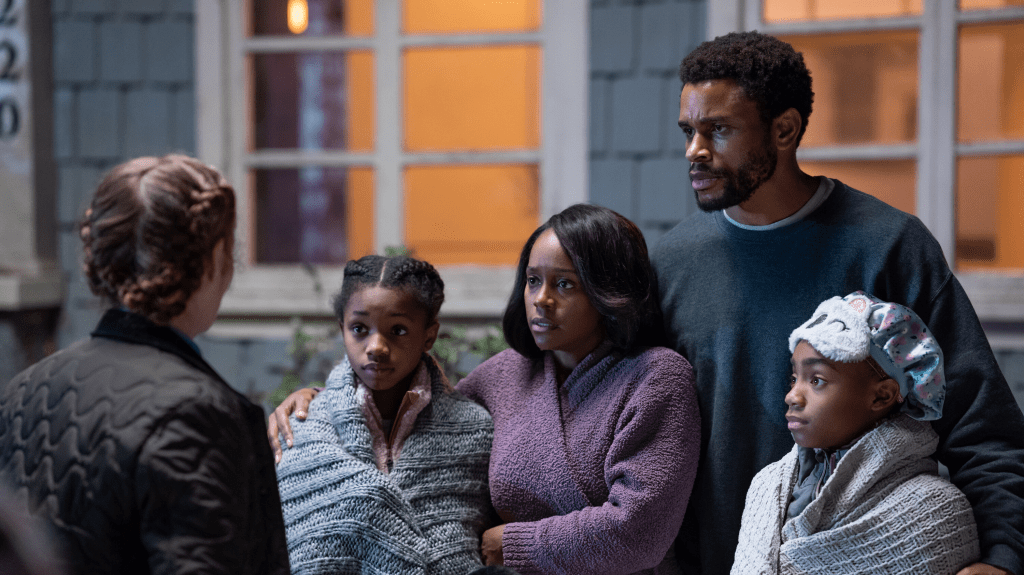
Asomugha crafts a story that is less about the “whodunnit” and more about the implications of how the case is handled. In a typical mystery, uncertainty drives the tension. Here, the transparency of the situation is what unsettles us, as the audience is pulled into the narrative alongside the characters. This approach builds suspense in a different way, one tied directly to the lived experiences of a Black family in America. What begins as a seemingly straightforward break-in at a family’s suburban home quickly spirals into a story about suspicion, scrutiny, and systemic bias—particularly directed toward the father, Chris (played by Asomugha himself). The case becomes less about justice and more about how narratives can be manipulated by those in power.
The setup is deceptively simple: a Black family living in suburban America, neither struggling nor depicted as affluent, simply living life. Chris is introduced as a hardworking, loyal father. His wife, Alexandra (Aja Naomi King), and their children, Kendra (Amari Alexis Price) and Riley (Aiden Gabrielle Price), complete the picture of a loving household. In the opening act, small details already foreshadow how perception can become weaponized. Chris, while doing renovations late into the night, has a beer before bed. When his kids notice the smell of alcohol on him, a tender but anxious moment unfolds as he begs them not to mention it to their mother, since he is supposed to be sober. This quiet exchange illustrates both his humanity and the pressure he feels to present himself as “perfect” within his home.
From there, the film pivots into its central conflict. After a tender moment between Chris and Alexandra, Chris hears noises downstairs and investigates—launching the family into a nightmare scenario. What should be a clear-cut case of a break-in becomes a study in the precarious role that Black families often find themselves playing when systems meant to protect them turn instead into mechanisms of suspicion and judgment.
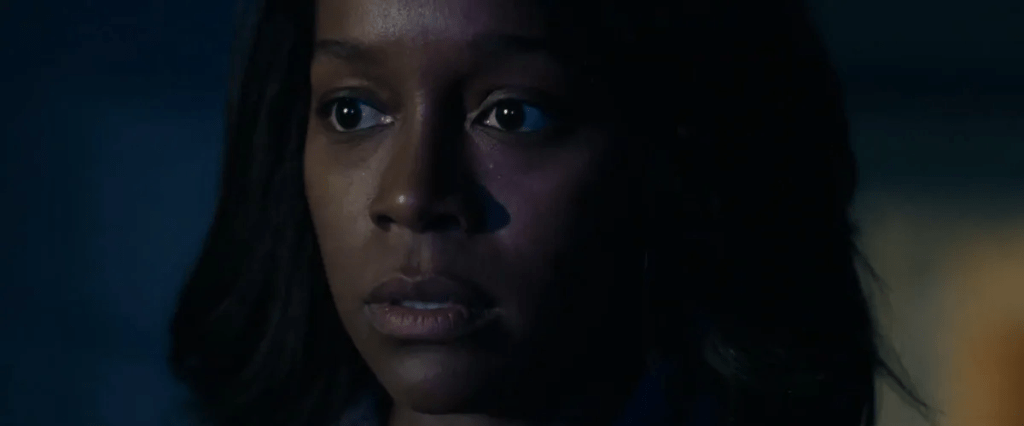
Cinematography plays a significant role in capturing this tension. Asomugha has acknowledged Hitchcock as an influence, and it shows. The use of shadow play, silhouettes, and darkness within the framing creates an atmosphere of unease that mirrors the family’s breakdown. By confining the story largely to the setting of the family’s suburban home, the film finds a claustrophobic intimacy, turning the space that should provide comfort and safety into one where the family is dissected, emotionally and systemically, by forces beyond their control. It’s a clever and unsettling choice: one location, multiple layers of fracture.
The pacing, too, works in the film’s favor. The setup of the family is brisk but effective—just enough time to glimpse who Chris and Alexandra are before the inciting incident tears into their lives. That quick introduction leaves an air of mystery about how they will respond as the story escalates. Asomugha doesn’t drag his feet; the film is relatively short, and he uses its runtime wisely. The dialogue is packed but purposeful, threading together character development and thematic depth without overstaying its welcome.
While the film doesn’t overtly genre-blend, its horror lies in its realism. On the surface, it’s a tense investigative thriller, but the true terror is in the way systemic racism turns a moment of victimhood into suspicion. Watching a Black family experience an unprovoked break-in should elicit sympathy, but instead, they are scrutinized and doubted. That shift transforms what might otherwise be a familiar crime drama into something that resonates as social horror. It isn’t horror in the traditional, supernatural, or slasher sense, but in the way reality itself can become nightmarish.
Initially, I questioned whether Asomugha was being too direct in his commentary. At times, the interactions between the family and the investigators felt a little on-the-nose. But the more I sat with it, the more I realized that this directness is true to life. These conversations aren’t exaggerated—they are a simple, almost procedural depiction of how these cases unfold, and that bluntness is precisely the point. Beneath the exchanges, there are subtleties: the family’s intentions, the quiet ways race factors into perception, the desperation in their attempts to prove their innocence. The dialogue works less as exposition and more as a vehicle for empathy, placing us squarely in the family’s distress.
The performances anchor the story. Aja Naomi King brings resilience and vulnerability to Alexandra, while the young actors lend the family scenes warmth and authenticity. Melissa Leo, however, is the film’s standout. As Detective Carlsen, she balances the empathy of a seasoned officer who recognizes the family’s pain with the hardened skepticism of someone who has seen countless cases. Her exchanges with Officer Padilla (Manny Jacinto) highlight how bias creeps in, sometimes unconsciously, shaping the investigation’s trajectory.
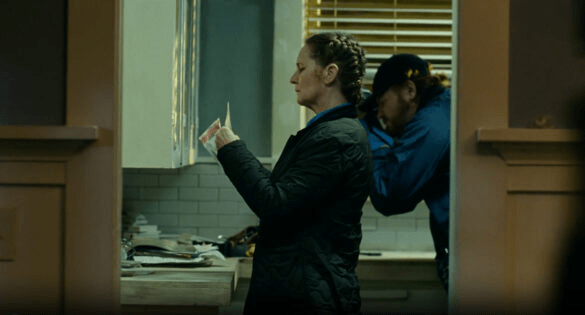
What sets The Knife apart is its simplicity. It doesn’t try to overcomplicate the case or add sensational details. The crime itself is ordinary, and that’s the point. By avoiding convoluted twists, Asomugha keeps the focus squarely on how the system itself compounds trauma. Its power lies in showing how even a seemingly mundane case can become suffocating when filtered through systemic prejudice.
The ending is perhaps its most striking element—realistic, unsettling, and impactful. Without spoiling specifics, it avoids offering easy catharsis. Instead, it lingers with frustration and reflection, unsettling in a way that forces the audience to sit with discomfort. It’s not a “good” ending in the conventional sense, but it’s one that feels truthful, which makes it all the more haunting.
As a directorial debut, The Knife succeeds by keeping its ambitions grounded in authenticity. Asomugha doesn’t overreach—he builds from personal experience as a Black man in America, telling a story that is straightforward but resonant. The Hitchcockian influences in his style hint at a filmmaker with an eye for psychological depth, someone who could easily expand into even more layered projects in the future. With Mark Duplass attached as producer, it wouldn’t surprise me to see Asomugha eventually straddle the line between socially conscious thrillers and horror in the vein of Jordan Peele. For now, The Knife proves that he has both the vision and restraint to craft a story that is simple in concept yet powerful in impact.
It isn’t flawless, but it doesn’t need to be. What matters is the emotional and systemic truth it portrays—a tale of a family victimized not just by a crime, but by a system eager to see them as suspects instead of survivors.
 818 Lens