Release Date: May 2, 2025 (U.S.)
Genre: Action | Superhero | Thriller | Drama
Runtime: 2 hours 3 minutes
Rated: PG-13
Writers: Joanna Calo, Eric Pearson, Lee Sung Jin
Distributor: Walt Disney Studios Motion Pictures
Production Companies: Marvel Studios
Cinematography: Autumn Durald Arkapaw
Music: Henry Jackman
MCU Placement: End of Phase Five
Thunderbolts* (2025)
Directed by: Jake Schreier
Starring: Florence Pugh, Sebastian Stan, David Harbour, Wyatt Russell, Hannah John-Kamen, Olga Kurylenko, Lewis Pullman, Geraldine Viswanathan, Julia Louis-Dreyfus
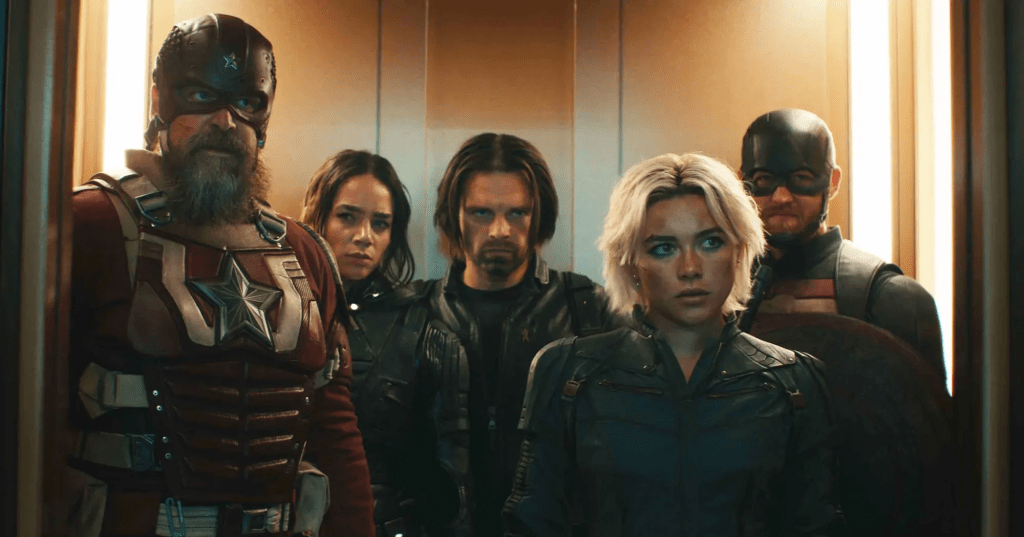
As much as they’ve been downplayed—and even joked about as the “off-brand” Avengers—the cast and crew behind Thunderbolts still manage to win us over, even without any flying abilities (as Yelena wryly points out in the film).
Marvel’s latest team-up film proves to be a step in the right direction—both as a satisfying conclusion to Phase Five and a promising spark toward what’s to come. Rather than trying to mimic the energy of previous Avengers films, Thunderbolts carves out its own identity by focusing on a group of antiheroes with a whole lot of baggage—and even more heart.
The film brings this ragtag team back together under chaotic, shady circumstances. They butt heads, argue constantly, and make questionable choices, but those moments are balanced with unexpected tenderness and chemistry—both between the characters and the actors who play them. You can feel the camaraderie on screen.
Jake Schreier’s direction, along with the screenwriting help from indie talents like Joanna Calo and Lee Sung Jin, lends the movie a slightly moodier, more grounded feel than what we’ve come to expect from Marvel. There’s a welcome freshness here, and though it doesn’t throw out the MCU formula completely, it tweaks it enough to stand out.
Visually, Thunderbolts leans into its title: shadowy, subdued lighting often serves as a metaphor for the emotional and moral weight carried by the characters. Thematically, it touches on grief, guilt, and the search for redemption without sensationalizing or softening its darker edges.
Florence Pugh is the clear standout. As Yelena, she leads with charm, pain, and strength—all without losing her signature bite. The emotional fallout from her sister Natasha’s death weighs heavily on her, and Pugh carries that burden with grace. She’s the heart of the film, and she owns it.
A pleasant surprise comes in the form of Lewis Pullman’s Bob (a.k.a. Robert). Pullman brings a surprisingly layered performance, managing to be both vulnerable and enigmatic. His dynamic with Yelena adds a compelling emotional undercurrent to the film.
Julia Louis-Dreyfus, as Valentina, continues to be a frustrating force—both manipulative and dryly hilarious when needed. Her background in comedy helps ease some of the film’s most tension-filled scenes, much like David Harbour’s Red Guardian, who continues to explore his complicated relationship with Yelena.
Geraldine Viswanathan also gets more screen time than expected as Mel, Valentina’s assistant. What starts as a seemingly minor role becomes something more morally complex as the story unfolds.
The rest of the squad—Ghost (Hannah John-Kamen), Bucky Barnes (Sebastian Stan), U.S. Agent (Wyatt Russell), and Taskmaster (Olga Kurylenko)—round out the ensemble. Each brings their own quirks and damage to the table, contributing to a team that works because of its dysfunction, not in spite of it.
Overall, Thunderbolts breathes some much-needed new life into the MCU. With its darker tone, indie flair, and more emotionally grounded storytelling, it offers a glimpse into what Marvel could become in the years ahead—less bombastic, more personal.
And with Fantastic Four: First Steps, Avengers: Doomsday, and Secret Wars looming in the near future, Thunderbolts feels like both an ending and a beginning. The unpredictability of what’s next might just be Marvel’s greatest asset right now.
 818 Lens