We all know Black Mirror episodes tend to echo and overlap, filled with easter eggs and thematic throughlines. While not a direct sequel, the recent episode “Plaything” connects to Netflix’s interactive feature Bandersnatch through a shared character: Colin Ritman (Will Poulter), the eccentric game designer who reappears in a brief but meaningful cameo. Both stories are set in stylized versions of the ’80s and ’90s, exploring the role of video games through dystopian, mind-bending lenses. These two works, when viewed side by side, offer a layered look at free will, determinism, manipulation, trauma, escapism, sentience, and loneliness—all told through the illusion of control and the interface of technology.
Black Mirror: Bandersnatch
Runtime: Variable; average viewing time is approximately 90 minutes, with a total of about 312 minutes of footage
Genre: Science Fiction, Drama, Interactive
Release Date: December 28, 2018
Streaming Platform: Netflix
Synopsis: Set in 1984, the film follows young programmer Stefan Butler as he adapts a choose-your-own-adventure novel into a video game, leading to a reality-bending journey influenced by viewer choices.
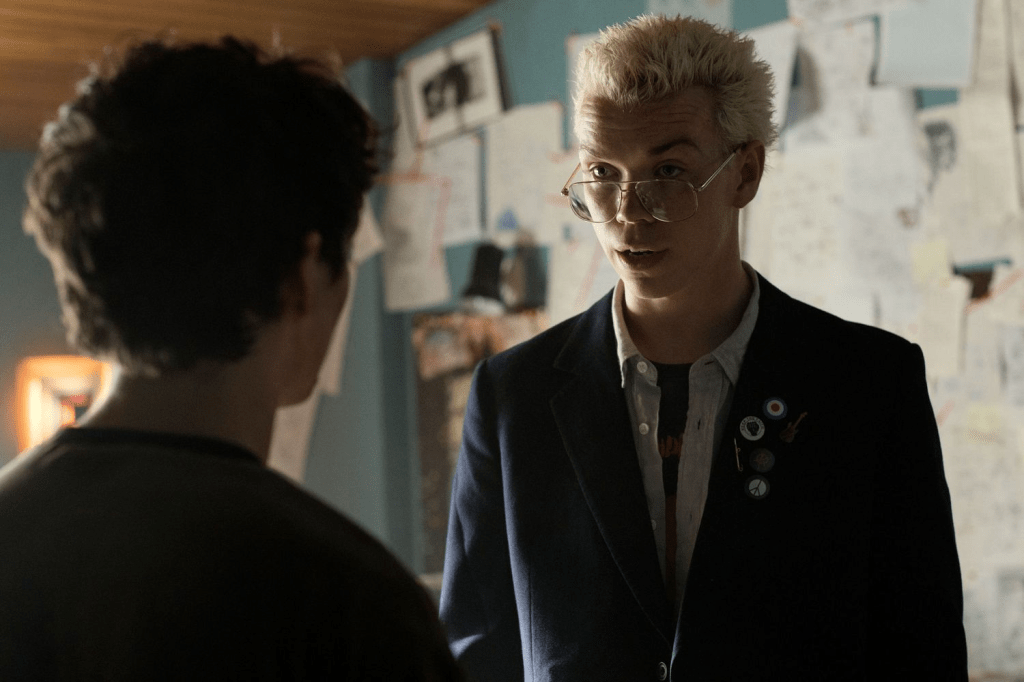
Directed by: David Slade
Written by: Charlie Brooker
Starring: Fionn Whitehead, Will Poulter, Craig Parkinson, Alice Lowe, Asim Chaudhry
Set in the ’80s, Charlie Brooker takes meta storytelling to another level with Bandersnatch, a choose-your-own-adventure experience that turns viewers into players and raises existential questions about agency. Stefan Butler (Fionn Whitehead), a young game designer, is working on a video game called Bandersnatch, based on a fictional choose-your-own-adventure novel.
The decisions you make start out innocuously—like picking a cereal or a song for your morning commute—but quickly grow darker and more consequential. What makes Bandersnatch so impressive is how those early, seemingly meaningless choices reappear later, proving just how curated and interconnected the narrative paths are.
At a critical moment, Stefan is offered a job to develop the game at a company. You choose: accept or decline? That choice—like many others—branches into radically different outcomes. I won’t go into every possible route (because part of the fun is experiencing it yourself), but let’s just say things escalate fast. Stefan spirals into madness, battling grief, control, and his own fractured reality. Whether it’s smashing his computer or yelling at his dad, the illusion of choice begins to unravel as Stefan becomes aware of you—the viewer—as a presence manipulating his fate.
One of Bandersnatch’s most powerful statements lies in how it explores trauma and creativity. Depending on your choices, Stefan’s game can be wildly successful or a critical failure. But the darker endings—those where he suffers or sacrifices the most—tend to lead to the highest-rated outcomes. There’s a chilling commentary here: that pain often fuels greatness, but at what cost?
The narrative becomes deeply meta when Stefan begins to sense someone is controlling him. Is it Netflix? Is it us? At one point, he even asks, “Who’s there?”—and we respond via the interface. The more decisions we make, the more the show pushes back. By the time you reach the post-credit scenes, Bandersnatch has deconstructed both its story and the idea of control itself. It’s a narrative labyrinth, a commentary on free will, and a psychological thriller rolled into one.
Black Mirror: Plaything
Runtime: 46 minutes
Genre: Science Fiction, Drama
Release Date: April 10, 2025
Streaming Platform: Netflix
Synopsis: In near-future London, eccentric loner Cameron Walker is arrested in connection with a cold case murder. His obsession with a 1990s video game, Thronglets, leads to unexpected revelations about digital life and human consciousness.
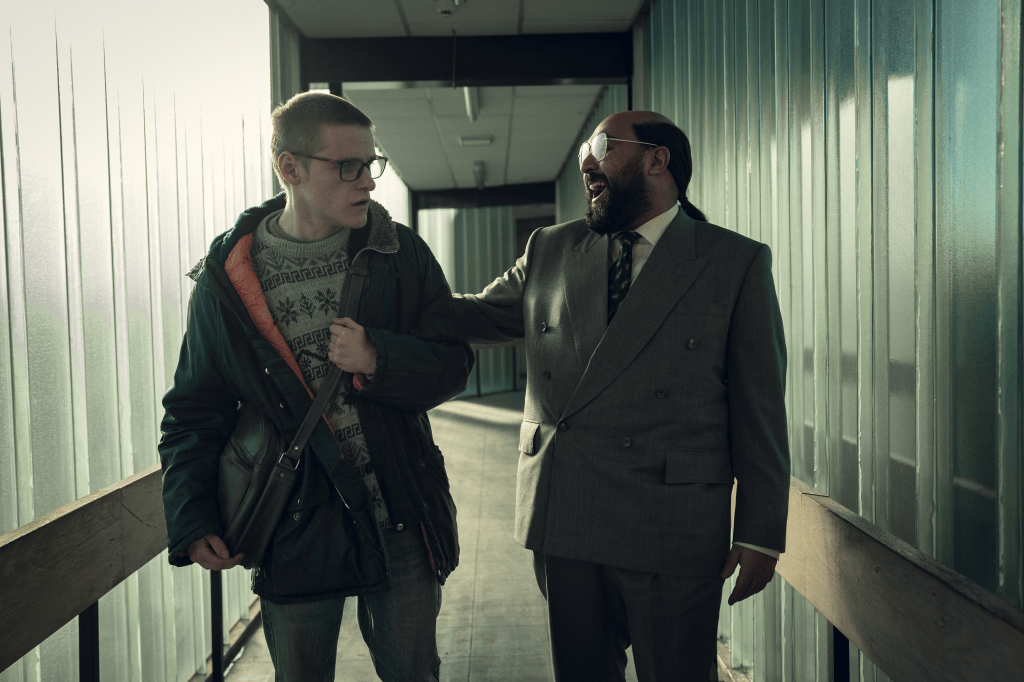
Directed by: David Slade
Written by: Charlie Brooker
Starring: Peter Capaldi, Lewis Gribben, Josh Finan, James Nelson-Joyce, Michele Austin, Will Poulter, Asim Chaudhry
In “Plaything,” we meet Cameron Walker (Lewis Capaldi), a man introduced mid-crime—though, as with most Black Mirror tales, not everything is what it seems. He’s brought in for questioning by DCI Kano (James Nelson-Joyce) and Jen Minter (Michele Austin), and slowly, we begin to uncover a layered story about sentience, technology, and isolation.
In flashbacks, Cameron (Lewis Gribben), as a young adult is shown to be a quirky, introverted reviewer who crosses paths with Colin Ritman—yes, that Colin—who recruits him to preview a new life simulation game called Thronglets. Colin explains the concept: fully digital beings capable of evolving independently, sentient AI with complex, unpredictable growth. He describes a world without violence, where code is biology and peace is the objective.
Back in the present-day interrogation, Cameron speaks cryptically about his past, particularly two relationships: one with his boss/editor, and the other with a freeloader named Lump who takes advantage of Cameron’s passive nature. It’s in these fragile relationships that the episode quietly explores Cameron’s loneliness.
Soon after taking acid—mirroring Bandersnatch’s Colin giving LSD to Stefan—Cameron believes the drug opens him up to “receiving” messages from the Throng. He begins upgrading his equipment to communicate with them: microphones, cameras, a growing obsession. When his boss asks about the Thronglets preview, Cameron delays, now fully consumed by the digital beings he believes are real.

The turning point comes when Lump, crashing at Cameron’s place, stumbles upon the simulation and wreaks havoc: burning, smashing, delighting in chaos. Cameron’s desperation peaks—he kills Lump in a fit of rage using a glass ashtray (visually echoing the one Stefan uses in Bandersnatch), all while the Throng watch through the webcam.
In the aftermath, Cameron calmly describes dismembering and disposing of the body—framed as an act of protection, not for himself, but for the Throng. We then witness a montage of him advancing the Throng’s technology over the years. Eventually, they design a neural interface, and Cameron drills it into his own neck, connecting his mind to theirs.
“The mind is a computer. The Throng, a code.”
– Cameron
He becomes their vessel. Their messenger. And the reason he’s at the police station isn’t to confess—it’s to initiate the Throng’s next phase.
After persistently asking for pen and paper throughout the episode, Cameron is finally granted it. He draws code, not words. The security system picks it up, and the Throng upload themselves into a transmissible signal. A high-pitched tone starts to emit across all devices, triggering a mass event.
In the final scene, people drop one by one as their minds are overtaken. Cameron, bloodied and smiling, offers his hand to Kano, welcoming him into this new world. The episode ends on a haunting POV shot—Cameron reaching out, his mission complete.
Thematic Parallels
Though Bandersnatch and Plaything are different in structure—interactive film versus traditional episode—their themes intersect in powerful ways. Both protagonists are young men grappling with isolation, creativity, and trauma. Stefan’s guilt over his mother’s death drives his descent, while Cameron’s social alienation leads him to find solace in artificial life. Both are manipulated—by viewers, drugs, or external forces—and both lose control in pursuit of something greater.
The use of video games as narrative devices raises profound questions about autonomy. In Bandersnatch, it’s about the illusion of free will. In Plaything, it’s about the power of creation and the consequences of giving life to code. Colin Ritman, in both stories, acts as a philosophical spark—a catalyst that sends each protagonist down a rabbit hole of their own making.
Ultimately, Plaything and Bandersnatch are two sides of the same coin: one asks who’s in control, and the other asks what happens when we give that control away. Both are chilling, thought-provoking, and unmistakably Black Mirror.
 818 Lens
One response to “Black Mirror: How ‘Plaything’ Echoes the Interactive Chaos of ‘Bandersnatch’”
10/10 would read again
LikeLike