Release Date: U.S. wide: January 9, 2026
Runtime: 128 minutes (2h 8m)
Rated: NR – for severe sex/nudity, profanity, drugs, and intense scenes
Production Companies: Scott Free Productions, Scala Films, CG Cinéma, Nevermind Pictures, Forma Pro Films, Curious Gremlin, Fremantle, Whiz Movies, Lorem Ipsum Entertainment
Producers: Michael Pruss, Dylan Meyer, Rebecca Feuer, Charles Gillibert, Yulia Zayceva, Max Pavlov, Svetlana Punte, Maggie McLean, Kristen Stewart
Cinematography: Corey C. Waters
Editing: Olivia Neergaard-Holm
Music/Composer: Paris Hurley
The Chronology of Water (2025)

Director: Kristen Stewart
Writers: Kristen Stewart & Andy Mingo
Starring: Imogen Poots, Thora Birch, Susannah Flood, Tom Sturrige, Kim Gordon, Michael Epp, Earl Cave, Esmé Creed-Miles, Jim Belushi, Anna Witowsky
Kristen Stewart’s feature directorial debut, adapted from Lidia Yuknavitch’s 2011 memoir of the same name, is not an easy pill to swallow — but that is very much the point. The Chronology of Water offers an unflinching look inside the life of a competitive swimmer navigating her family, her trauma, and her eventual outlet through writing. Lidia (Imogen Poots) exists in a near-constant influx of emotional turmoil, repeatedly challenged by circumstance, memory, and the lingering presence of her father, who remains at the center — and the origin — of much of her pain. Stewart challenges herself to honor Yuknavitch’s vision with care and intention, adapting the text without imposing boundaries or softening its edges. What results is a messy, fully committed effort from Stewart and her cast and crew — a portrait of womanhood and survival that is all too familiar, painfully honest, and deeply specific to Lidia’s lived experience.
The imagery throughout the film is undeniably striking, particularly as it jumps across different periods of Lidia’s life, but that aesthetic beauty comes at a cost when weighed against the darkness of the subject matter being explored. The film is broken into fragments and segments, and true to its title, remains intentionally disordered in its linear structure. Memories bleed into one another, resurfacing at unexpected moments, much like they do in real life. Certain experiences in our present have the power to awaken memories long buried — even those we would rather keep repressed. Stewart leans into that instability, allowing the audience to feel disoriented, unsettled, and unsure of where they are in time. It is not always comfortable. It is not convenient. But much like Lidia herself, viewers are forced to sit with that discomfort, to process these emotional disruptions without the relief of clarity or resolution, mirroring how she navigates her own memories at varying levels of emotional capacity.
Imogen Poots delivers what is undeniably a career-best performance, embodying multiple stages of Yuknavitch’s life with an intensity that never feels performative. Her portrayal captures the brutal, unfiltered realities of womanhood — particularly when confronting sexual abuse and the long-lasting psychological aftermath that follows. It is a delicate tightrope to walk: presenting a character whose emotions can feel erratic, overwhelming, and at times irrational, while still grounding her actions in something deeply human and understandable. Poots succeeds by allowing Lidia to exist in contradiction — impulsive yet introspective, self-destructive yet searching for autonomy — without asking the audience to excuse her behavior, only to understand it.
She throws her full self into the role emotionally, but what deserves equal recognition is the physicality of her performance. Much of the trauma Lidia carries is tied directly to the body — its autonomy, its violation, and the complicated relationship one has with it after that autonomy has been stripped away. Stewart’s direction allows the body to remain present rather than symbolic, emphasizing how deeply physical trauma embeds itself into one’s identity, particularly when sexuality and control are involved. Poots communicates as much through posture, movement, and stillness as she does through dialogue, reinforcing how trauma often lives beneath language.

Lidia’s sister, Claudia (Thora Birch), is revealed much like Lidia herself — in fragments. She remains elusive for a significant portion of the film before slowly coming into focus, her adult life shaped by the same household but filtered through a different emotional response. Where Poots’ Lidia often exhibits volatility and restlessness due to unresolved trauma, Claudia offers something more grounded, embodying endurance rather than rupture. Lidia may be the emotional center of the story, but Stewart ensures that the women around her are not sidelined. They, too, experience harm at the hands of the same father, each processing and surviving it in their own way.
We also witness Lidia’s mother, Dorothy (Susannah Flood), navigating life alongside her daughters while remaining tethered to the man responsible for their suffering. Through Dorothy and Claudia, Stewart highlights the generational and cultural differences in how women are taught to endure, survive, or remain silent. When it comes to Lidia’s love life, the film portrays her exploration with both men and women, emphasizing her openness and spontaneity. Her relationships with women, in particular, are depicted as spaces of safety, intimacy, and reclamation — moments where she is able to explore sexuality without the weight of fear or expectation. While men enter and exit her life in meaningful ways, it is evident that Lidia finds a unique form of solace and understanding in her connections with women, often communicating volumes through a simple exchange of looks or shared vulnerability.
Stewart’s directorial style incorporates retro-inspired transitions and visual effects that lend the film a nostalgic texture, often tinged with dread. Water emerges as the film’s most prominent recurring symbol — not merely as an aesthetic motif, but as an emotional and physical language. Lidia’s relationship with water mirrors her internal state, adapting to her circumstances just as she does. When she seeks release or catharsis, water becomes her refuge. Her memories, like water, are fluid, formless, and resistant to structure. The film draws subtle parallels between water and the body — its fluids, its responses, its instincts — reinforcing how identity, trauma, and survival exist in constant motion. Water is not a fixed metaphor; it is adaptable, expansive, and ever-changing, much like Lidia herself.
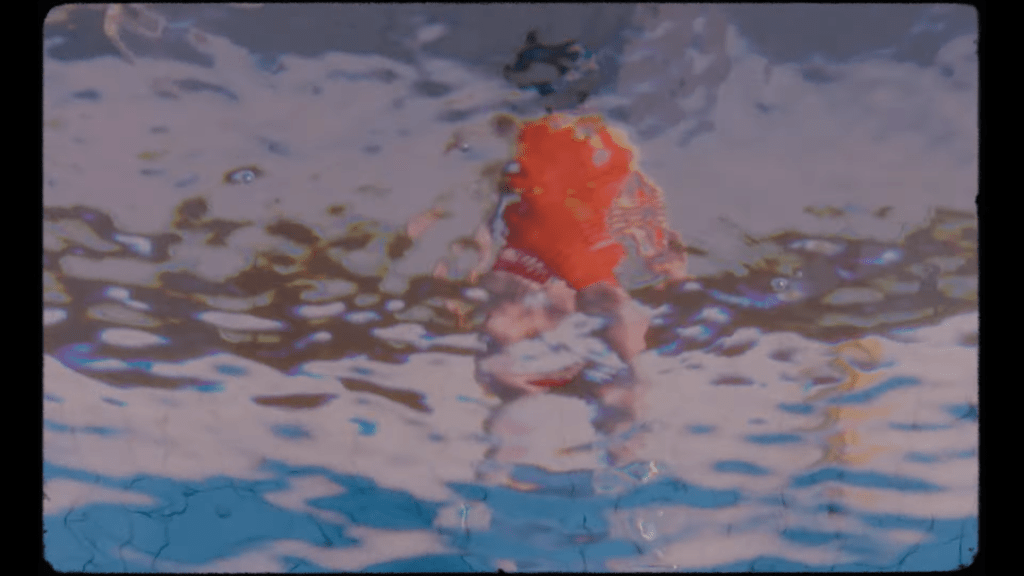
Ultimately, what Stewart captures with painful accuracy is Lidia’s inability to achieve conventional closure. Like many survivors, Lidia is not granted a clean resolution or a sense of finality. Instead, she is forced to live alongside her trauma. Water, which once served as an escape from her father and a timeline of her memories, becomes a means of adaptation — a way to mold herself around what she has endured. Closure, in this sense, is not something she receives, but something she learns to live without. Writing becomes her outlet, her means of survival, and her way forward.
Throughout the film, Stewart remains faithful to the unfiltered nature of Yuknavitch’s memoir — an honesty that many adaptations shy away from. Little is left to the imagination, yet enough restraint is exercised to prevent the film from slipping into exploitation. The audience is made to feel everything Lidia feels, often to the point of extreme discomfort, which only reinforces the film’s emotional effectiveness. Yuknavitch’s strength as a writer lies in her ability to recount deeply personal moments with brutal clarity, and Stewart honors that by allowing the film to remain raw, intimate, and uncompromising.
The Chronology of Water is not a film for the faint of heart. One can only imagine the emotional toll required of both Poots, in portraying Lidia with such vulnerability, and Stewart, in guiding a project that demands constant emotional exposure. It is a narrative that takes its time unraveling every fragment of Lidia’s life — and rightly so. Each memory released functions as another building block, contributing to a portrait that is catastrophic in its pain yet beautifully constructed in its honesty. What emerges is not a story of healing, but of endurance — a memoir brought to life with integrity, intensity, and an unyielding respect for the truth it carries.
 818 Lens