Release Date: September 19, 2025 (USA)
Runtime: 96 minutes (1 hr 36 min)
Rated: R — for strong bloody violence, language throughout, sexual material, nudity and some drug use
Production Companies: Monkeypaw Productions
Producers: Jordan Peele, Win Rosenfeld, Ian Cooper, Jamal M. Watson
(Executive Producers: David Kern, Kate Oh)
Cinematography: Kira Kelly
Editing: Taylor Joy Mason
Music / Composer: Bobby Krlic
HIM (2025)
Writer(s): Zack Akers, Skip Bronkie, Justin Tipping
Starring: Marlon Wayans, Tyriq Withers, Julia Fox, Tim Heidecker, Jim Jefferies
What could have been an intriguing and intimate exploration of its concept is, unfortunately, compromised for style. As visually stunning as the film is—and as clever as some of its editing choices may be—it ultimately fails to engage deeply with the themes it raises. Instead, it lingers at the surface, teasing the audience without ever offering the depth or revelations that the setup promises.
Tyriq Withers stars as Cameron Cade, an aspiring football player living under the weight of a legacy set forth by his father. From early childhood, Cameron is pushed toward greatness, seemingly in service of his father’s ambitions as much as his own. He grows up carrying the burden of dreams not entirely his, as if his father is attempting to live vicariously through him. What works against the film is its refusal to explore Cameron’s upbringing in more detail, leaving us with little insight into his psychological or emotional landscape. This omission is especially glaring when considering the film’s potential to interrogate the physical, emotional, and mental sacrifices demanded by professional sports.

Opposite Withers is Marlon Wayans as Isaiah White, a nearly retired football player who once overcame a devastating injury to return to the field and ultimately claim eight championship rings. On paper, Isaiah’s arc offers fertile ground for examining sacrifice, resilience, and the toll of chasing greatness. Yet, as with Cameron’s story, the film barely scratches the surface. The themes of legacy, idolization, and the suffocating expectations of familial and cultural pressure are all present, but they remain underdeveloped and fragmented. What, truly, drives Cameron toward his goals? Clearly his father’s influence looms large, but what draws him specifically to Isaiah White and his legacy? The film gestures toward answers but never commits to exploring them.
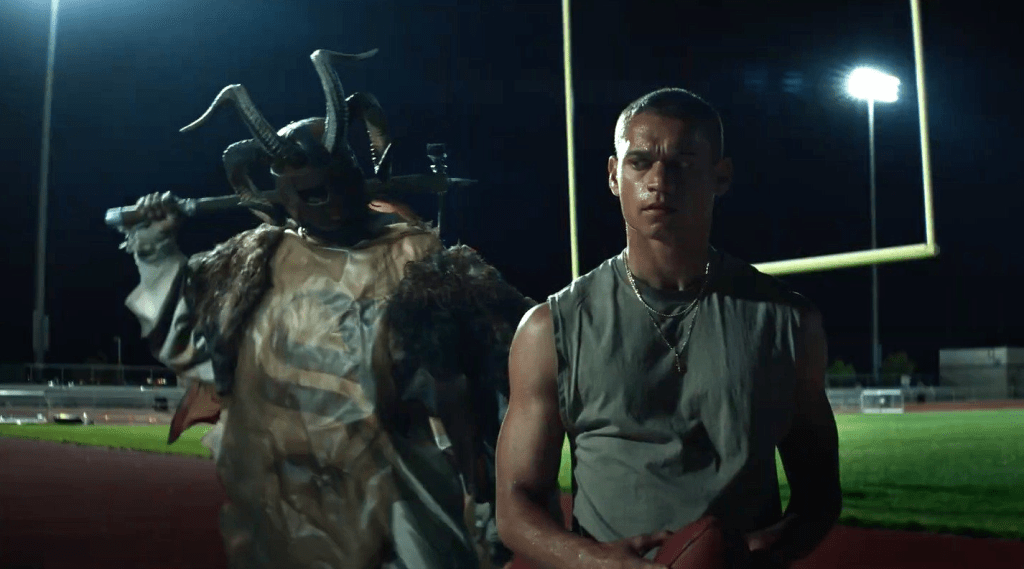
If Him succeeds anywhere, it’s in its aesthetics. The cinematography is striking, and certain editing techniques sharpen the tension. Yet, the fractured narrative and lack of closure on multiple story threads leave the film messy and unsatisfying. Withers and Wayans do admirable work with what they’re given, delivering performances that are entertaining if not entirely layered. Julia Fox, too, adds texture where possible. But the material simply does not support the depth these actors are capable of. The bones of a strong, ambitious movie are clearly here, but rather than building out its structure, the film seems content to admire the surface—flesh and skin without the connective tissue beneath. At times, the audience is left to fill in far too many gaps, while extraneous storylines arrive at awkward moments and ultimately lead nowhere.

The setup holds promise, and the film is intermittently entertaining. But as it progresses, it becomes clear that the nuance it hints at will not be realized. Where Him truly shines is in its surrealist flourishes, blending sports drama with horror elements to evoke the psychological and emotional turmoil of athletes—particularly those grappling with the physical consequences of traumatic brain injuries. This merging of sports and horror is inventive and fertile territory for storytelling. Yet, once again, the film fails to fully commit, leaving the innovation underutilized. Perhaps that is the point: that this is only the beginning of a new subgenre, a starting point rather than a definitive statement. But for now, the stylish aesthetic is prioritized over the more daring and necessary explorations of sports culture and its darker undercurrents.
I don’t want to be overly harsh, because I don’t believe Him deserves the wave of negative criticism it has been receiving. Tipping and Peele clearly aimed to accomplish something distinct, and the execution is often confident. But it’s frustrating to see Wayans’s character left underdeveloped, when his story could have provided the crucial emotional and thematic balance the film needs. The father-son dynamic, Cameron’s fascination with Isaiah, and the toxic fandoms of professional sports are all potent narrative threads that never quite intertwine in a meaningful way. Even the film’s segmented structure, marked by on-screen titles, feels like an unfulfilled device, leading to an ending that is tonally inconsistent with the rest of the film.

There is a recurring sense of missed opportunity. Him presents provocative ideas—about legacy, sacrifice, fandom, and the human cost of sports—but the delivery becomes convoluted. It’s not about demanding airtight plausibility; cinema often thrives with ambiguity and imperfection. But when so many narrative threads remain unresolved, what lingers is not mystery but frustration.
Ultimately, I still encourage audiences to seek out the film for themselves. There are viewers and creators alike who may prioritize aesthetics and style over narrative, and for them, Him may resonate more strongly. For me, however, the imbalance between style and substance works against the film’s ambitions. While Withers, Wayans, and Fox are consistently engaging, the groundbreaking territory this film might have carved remains largely untouched. In the end, Him is a film of tantalizing promise but frustrating execution.
 818 Lens