Release Date: May 9, 2025 (United States)
Runtime: 96 minutes
Country: United States
Language: English
Genre: Horror / Slasher
Rating: R (for bloody horror violence)
Based on: The 2020 novel Clown in a Cornfield by Adam Cesare
Production Companies: Temple Hill Entertainment and Rhea Films
Distributor: RLJE Films and Shudder
Clown in a Cornfield (2025)
Director: Eli Craig (Tucker & Dale vs. Evil)
Screenwriters: Eli Craig and Carter Blanchard
Starring: Katie Douglas, Aaron Abrams, Carson MacCormac, Vincent Muller, Kevin Durand, Will Sasso, Cassandra Potenza, Verity Marks, Ayo Solanke, Alexander Martin Deakin
A blood-splattered satire of generational tension, small-town decay, and killer clown chaos
Shudder continues to back projects that embrace risk — and Clown in a Cornfield is a perfect example of how horror keeps evolving alongside our culture. As the genre reacts to shifting generational values and growing social divides, Eli Craig and Carter Blanchard deliver a horror-comedy slasher that taps into that cultural friction while still keeping the scares and laughs flowing.
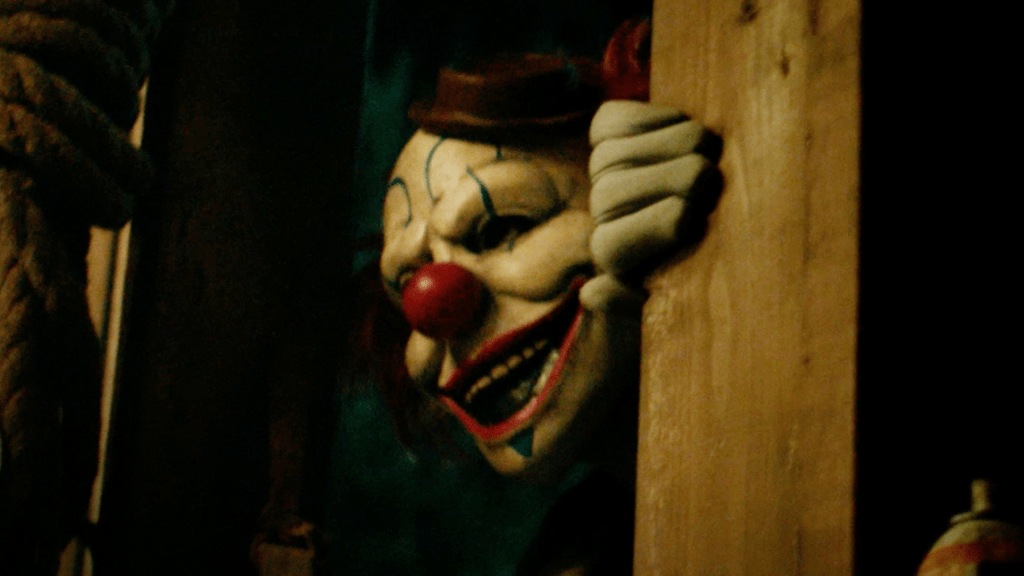
While some may call its approach formulaic, the film cleverly balances eerie tension with timely humor. The cornfield setting is used to haunting and entertaining effect, and Frendo — a terrifying, small-town mascot-turned-killer — becomes the perfect slasher symbol of a community clinging to a bygone era. The economy of Kettle Springs once thrived thanks to the Baypen Corn Syrup Factory, and now it’s limping along, weighed down by resentment, nostalgia, and a rift between generations. Enter Quinn (Katie Douglas) and her father, Dr. Maybrook (Aaron Abrams), a newcomer duo hoping to start fresh but finding themselves tangled in a town ready to boil over.
The slasher setup feels familiar — teens in peril, masked killer on the loose — but Clown in a Cornfield sets itself apart through satire. The young cast (Carson MacCormac, Cassandra Potenza, Verity Marks, Ayo Solanke, and Alexander Martin Deakin) breathes life into what starts off as an online prank involving a faux Frendo sighting, only for the killings to become real. The group’s initial camaraderie and prank culture quickly dissolve as they realize they’re no longer in control of the story — a literal and figurative comment on how older systems still hold the power, even when the younger generation pushes back.
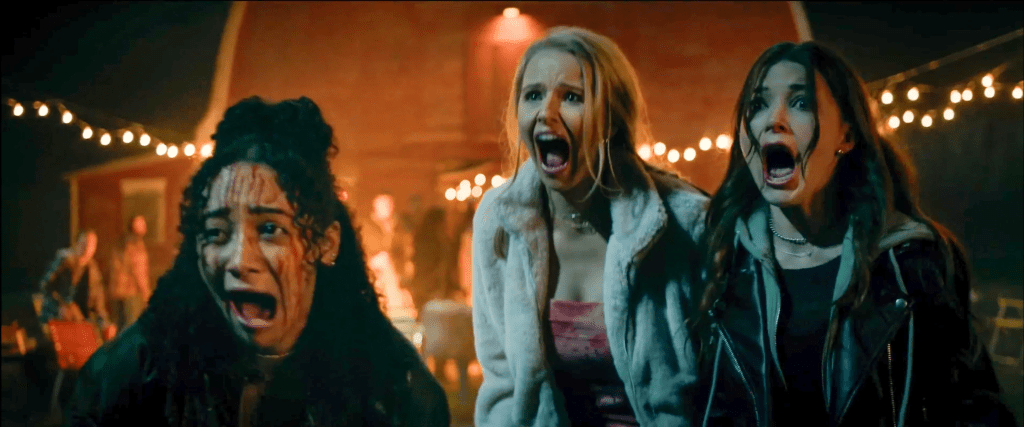
What the film also taps into — and rather effectively — is the isolation that can come from existing within a generational divide. These teens don’t just represent youthful rebellion; they represent a push for progress in a town that’s stubbornly holding the line. They’re trying to act, not just endure, and the horror stems as much from that cultural pushback as it does from the actual violence on screen.
Clown in a Cornfield imagines a society where traditions remain unchallenged — not out of necessity, but out of fear, control, and comfort. The film’s adults, especially those who remain faceless or underdeveloped, serve as metaphors for outdated systems and rigid institutions. Their refusal to evolve becomes its own kind of violence — one that’s masked, literalized, and unleashed. In contrast, Sheriff Dune (Will Sasso) and Arthur Hill (Kevin Durand) are two of the only adults granted deeper characterization. While still hardened and often stern, they occasionally reveal flashes of vulnerability and humanity, making them feel like part of a world in flux rather than frozen in time.
Frendo, meanwhile, is a standout among cinematic killer clowns. Not because of some grotesque new gimmick, but because of how familiar — and marketable — he is. He’s not crawling out of sewers or tormenting people for sadistic pleasure. He’s Ronald McDonald by way of Americana horror: a nostalgic mascot, a logo, a legacy. He represents the face of a town built on profit, tradition, and appearances — a town that uses him to mask decay, resentment, and fear of the new.
What Craig and Blanchard also achieve — and it shouldn’t go unnoticed — is real emotional texture. They give these teens more than just one-liners or body count value. There’s empathy in the way they’re written, even in a movie this fast-paced and heightened. The characters are layered, emotionally reactive, and grounded enough that their fates feel like they matter. The horror has stakes because the kids feel real.
Clown in a Cornfield doesn’t reinvent the wheel, but it sharpens the blade. Its visual flair, effective kills, and commentary on the push-pull between tradition and progress give it purpose beyond the body count. It’s more stylized and satirical than its source material, but the core themes — generational conflict, societal rigidity, and the fear of change — still bleed through. Frendo may not reach the terror heights of Terrifier’s Art the Clown, but he earns his spot in the killer clown canon with a presence that’s equal parts ridiculous and chilling.
It’s a fun, twisted ride — and one that knows exactly what it wants to say.
 818 Lens